Wednesday, January 7, 2015

Mom's Organic Market

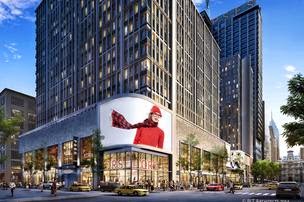
It looks like Mom's Organic Market will be moving into the 11th Street component of the massive East Market project currently under development on the Girard Trust Block. While it's great that Philadelphia will finally have a supermarket on par with Whole Foods, or even SuperFresh, closer to the core of its residents, what's even more exciting is the facelift the former Family Court Building will receive.

Once a warehouse for Snellenberg's Department Store, the old Family Court Building is faded and its facade is cracked and worn. Rather than restore the building's exterior, developers will be refacing it to include modern elements and large windows.

The new skin could have been as dramatic as that at Goldtex Apartments, but given the sum of the parts of the overall project, it doesn't have to be. The high-rise that will be anchoring 11th and Market looks sexy enough to carry the entire block. By slicing the block bound by Market and Ludlow in half for a pedestrian promenade, East Market isn't afraid of sacrificing land for a quality experience. 

They're carrying that theme over to the old Family Court building by opening up a good amount of the building's square footage to the outdoors. Center City's most exciting project (sorry, CITC) keeps getting more exciting.

Saturday, January 3, 2015

Roman Catholic Expansion

I was just gushing about the recent improvements and proposals for Vine Street, namely the Church of Jesus Christ of Latter Day Saints' decision to embrace one of the street's least desirable lots for a residential high-rise. 

Others are following suit. What's ever better, the development will replace yet another surface lot that scars the cityscape leaving Vine Street a hostile avenue for pedestrians.


Roman High (quite possibly the most badass named high school in the country, with a building to match) has acquired a neighboring lot, and has released preliminary plans to build a much-needed gymnasium. It also purchased another parking lot on north 13th Street that currently stores U-Haul trucks, for the school's fine arts expansion. A fitting location considering this lot was once home to Eraserhood's own, the renowned creator of Twin Peaks and the neighborhood's namesake, Eraserhead, David Lynch.

I'm not sure how the Catholic church feels about Lynch's creepy and deliberately offsetting creations - or nightmares - but maybe the school could dedicate a dark corner or a janitorial closet for a Lynch Museum. 

What are the Mummers?

After eleven years in Philadelphia, I still don't exactly know. And I think that's what I like about it. I've read the Wikipedia page, I know it's not completely rooted in Philadelphia. But over time it's become uniquely Philadelphian.

I always have friends from DC or New York in for New Years, and every year one invariably asks, "What is this?" Well, it's not "kind of like Mardi Gras," it's not "kind of like Carnivale." It's just...the Mummers. 

Unlike Rio or New Orleans, inherently Philadelphian institutions fly under the radar like our city itself. That's part of what makes Philadelphia such a wonderful city. The Mummers Parade hasn't become - and never will become - an insufferable New Years Even in Time's Square. Our history hasn't been tainted by commercialized nostalgia and annual obligations because Philadelphia is the national embodiment of the word "nostalgia." Nothing and everything is nostalgic about Philadelphia because we never severed ties with our history. 

The Mummers aren't a hackneyed resurrection because they never left. Our history can't be exploited because we still live it. We're home to the nation's first Thanksgiving Day Parade (deal with it, New York). We are history, and whether that's evolved to become a Rocky Run or hoards of drunk locals parading through the streets in clown makeup or comical drag, it's beautiful. Keep it coming.

Thursday, January 1, 2015

2014's Best Proposal

Welcome to the New Year, and a new Philadelphia. 2014 gave us marriage equality and decriminalized marijuana. And while our skyline was forever altered prior to the Great Recession, the city is poised for another architectural renaissance that won't just change the way we look at Philadelphia, but how we interact with it.

Sure, Comcast is building the tallest American building outside New York and Chicago. But the Church of Jesus Christ of Latter Day Saints and FMC are breaking convention by building tall north of Vine Street and west of the Schuylkill River. Whatever you think of Comcast Center, these other projects are true game changers. They will bridge gaps, extending what we think of Center City beyond its psychological barriers. 

But altering the way we see a city from the interstate is only part of what makes a city. Tall buildings can be purely aesthetic. Ask Los Angeles or Dallas. 

Philadelphia knows better.


Despite new heights being reached north, south, east, and west, the most influential project under development right now is taking place on Market East. NREA's East Market is clearing and rehabbing the Girard Trust Block for a massive mixed use complex bound by 11th and 12th. The project includes shopping, entertainment, restaurants, and a mid rise apartment tower, perhaps two.

In University City this might not seem so exciting. Hell, it wouldn't be unheard of in Conshohocken. But in Center City, developers tend to build up. East Market isn't necessarily tall, at least night in a city where we tend to look vertically. But Center City hasn't attempted a mixed use project on this scale since the Gallery at Market East. And unlike the Gallery, East Market isn't an attempt to offer urbanites suburban woes, it's offering city residents a slice of modern urbanism.

Its storefronts face the sidewalks, and it sacrifices land for even more pedestrianization by slicing the block in half. It's ambitious, but not blindly. It's finally giving Philadelphians what they want on Market East, what they've wanted for fifty years, and what it was a century ago: a shopping hub. 

It's called "Market Street" for a reason.

Sure, I may be gushingly deviating from truly Philadelphian pessimism, but it comes from a realistic place. East Market isn't another Gallery, it's the Gallery-done-right. The only reason it seems risky is because the Gallery is its only analogy. Architecturally, East Market is nothing special. Its modernity is carbon-copy, its tower looks like many built in the early 21st Century. The excitement of its renderings stems from plasma screens and flashy advertisements. But where East Market deviates from large projects past is its sustainability. 

It's engaging, it's smart, and it answers to what residents have been long asking for. It makes Market East feel less an island of poor urban planning and more like an integrated part of Philadelphia. Smart architecture doesn't just exist like Comcast Center or Centre Square, it engages the community and encourages future growth like Dilworth Park or the Piazza. It recognizes the fact that cities aren't just isolated buckets, but pieces of a larger whole. East Market isn't just good urbanism, it begs developers for more.

Sunday, December 28, 2014

Game Changer

Game Changer
1601 Vine Street has spent decades as a surface parking lot, one of many that line the Vine Street Expressway. Despite numerous proposals - some more realistic than others - it seemed that it would forever exist as a reminder of what the expressway's construction did to the surrounding blocks. 

Despite its proximity to Center City, developers are leery of taking a chance on Vine Street.

It's full of traffic. It's loud. It's devoid of pedestrians. It's risky.

The Loft District just north of Vine Street has seen a marginally successful renaissance but it still feels like another town, one a short walk from the center of the city. 

The canyon that separates the north and south is more of a mental barrier than a physical one. Other cities have highways cutting through densely populated areas but they succeed because the surrounding infrastructure allows them to be densely populated. When high-rises and skyscrapers embrace a highway, walking across it is less daunting.

That isn't the case in Philadelphia. Vine Street is lined with surface parking lots and a few structures lingering from the neighborhood's era as a slum. 

But that's changing in a big way. The Church of Jesus Christ of Latter Day Saints is building a residential high-rise next to its new temple at 16th and Vine, and it appears prep work has begun. 

So what's the big deal? The vicinity known as Franklintown is chock full of apartment buildings. It's on the better, west-of-broad stretch of Vine. 

Well, it's a big deal because this may be one of the most undesirable lots in Center City. It doesn't just sit above the Vine Street Expressway, it sits next to the highway's exit ramp. It's also a big deal because the Mormon church has the money to build quality, and they usually do. This is a building designed by Robert A. M. Stern's renowned firm, one that could easy find a home on cushy Rittenhouse Square. 

It's changing the game, not just for Franklintown, but also for Vine Street. If it succeeds it tells developers and residents that the Vine Street Expressway isn't the barrier they thought it was, just a short, boring block to walk past. It will also bring more residents, more pedestrians to Vine Street, which means the city will be pressured to address the street's piss-poor pedestrianization, the kind of headaches finally being tackled on Washington Avenue.

In a few years, Vine Street and the neighborhoods just north might be the integrated part of the Center City they should be. 

Monday, December 22, 2014

Your Christmas Watch List

If you're looking for some good Christmas movies, avoid the lists. Personally, I love The Christmas Story, but I honestly can't tell you why. The 1983 sleeper classic is cute, offers up nostalgia that most generations can relate to, and has a a couple laugh-out-loud moments that would still be funny if TNT didn't spend the last twenty years shoving it in everyone's face. But at the end of the day, this simple story that Ted Turner turned into an industry all its own, is about a whiney brat begging everyone he sees for a gun. 

So if you're home for the holidays this year and find yourself trying to stomach creepy stop motion elves and wondering if Charlie Brown is actually Kirk Cameron in disguise, check out these forgotten Christmas movies, or movies you might have forgotten are actually Christmas movies.

Trading Places

I'm starting with Philadelphia because, well, Philadelphia. You all know that this 1983 hit takes place at home. If you want to remember what Philadelphia looked like back when it was a mess, just Google it. Its opening montage pairs bougie Rittenhouse Square with gritty pictures of flaming oil drums and a porn theater sidling right up to City Hall. It's also freaking hilarious. 


Gremlins

Forgot Gremlins was a Christmas movie, eh? Yep. The 1984 hit was supposed to be a comedy, but it was a little too dark for some viewers. Because it sent so many kids screaming from the theaters, my eight year old self included, it prompted the Motion Picture Association of America to install a PG-13 rating. Remember that scene when Phoebe Kates described finding her Santa-suited father dead in the chimney? That was supposed to be funny. By the way, at 51, she's still as hot as she ever was.

Caroling

Christmas in Connecticut

I don't know if this movie is an established classic or not, I only discovered it a couple years ago. But being an architecture nerd, any aficionado of the built environment can easily become obsessed with the movie's mansion. It's also surprisingly modern, and funny, for a movie that came out in 1948. 


Christmas Vacation

The Griswold's third National Lampoon's installment might be as overplayed as The Christmas Story, but that doesn't make it any less watchable. The smutty magazine's take on family never ceases to entertain (except maybe in Las Vegas), and their Christmas adventure is perhaps its most depraved, "Don't forget the rubber sheets and the gerbils." And look closely, Julie Louis-Dreyfus plays the quintessential 80s yuppy next-door. "I don't know, Margo!"

"250 strands of lights, 100 individual bulbs per strand, for a grand total of 25,000 imported Italian twinkle lights."
Scrooged

I saw Scrooged at the historic Virginia Theater in my hometown shortly before it was torn down. I don't know about you, but I find Charles Dicken's A Christmas Carol to be his worst piece of literature. Maybe in 1843 people expected less. But his 1-2-3 approach to telling this story made it tedious, boring, and mind numbingly predictable. Scrooged, on the other hand, one of hundreds of retellings of A Christmas Carol, is still fresh. I don't know if it's the nostalgia of first watching this movie in a grand old cinema palace, or the fact that it's the funniest version of Dicken's inexplicable classic, but twenty four years later it still entertains me. From Mary Lou Retton as Tiny Tim to the Solid Gold Dancers ("Well I'm sure Charles Dickens would have wanted to see her nipples"), it's both a riot and adorable.

Merry Christmas!


Fate of the Boyd Uncertain, Again

Months ago, at the height of an effort to save Philadelphia's last surviving movie palace, the Historical Commission proved that it knows as little about history as it does preservation by approving the demolition of the Boyd's auditorium.

Neil Rodin promised he'd deliver us an iPic movie theater if Live Nation, its previous owner, cleared the way. Now that the auditorium, perhaps the building's most worthy attribute, is nearly gone, Rodin is out of the picture and the property has been purchased by Pearl.

Pearl Properties pitched a sky scraping apartment building for the now-vacant corner of 19th and Chestnut last summer, but its height and density upset neighbors. Now that it owns the Boyd, the art deco-ish apartment tower can be built without the headache of a zoning variance. 

So what about the Boyd? Well, Hamid Hashemi of iPic insists that it's still interested in leasing the Boyd from Pearl, but Inga Saffron pointed out Friday that iPic could only afford Rodin's cheap rent, and that Pearl has no interest in the movie business. 

Of all the theaters that graced Philadelphia with the birth of celluloid, it's a shame that the Boyd is the only to survive. While its auditorium is indeed beautiful, the only protected piece - its facade - is the building's least interesting attribute. 

As for the historic building, its classification only protects the facade, one that would complement Pearl's proposed tower. But at this point, does it matter? Unless Pearl intends to restore the Boyd's lobby and incorporate it into the tower as its entrance, the theater's face is its least interesting piece. Like ghost structures and shadow walls, salvaged facades can be bitter reminders of history we lost.

Even if Pearl is willing to entertain iPic's proposal and match Rodin's low rent offer, it seems like a poor business move. In fact, iPic's general business model seems like it's designed to fail, or at best, it's not sustainable. Blankets and recliners aren't innovative ways to draw fleeing viewers back to the silver screen. That's like putting a coffee shop in a Blockbuster then doubling the rental price in exchange for the experience. 

If I want to cozy up to a movie, I've got Netflix and a cat at home. I'm not going to spend twenty plus dollars to fall asleep in a room full of strangers. 

As a vintage movie theater, the Boyd's original auditorium would have offered something unique, and the vacant lot next door could have been annexed to provide another screen or two. iPic's bandaid approach to its dying industry never had a realistic future on Chestnut Street, and unless it begins to understand why Millennials would rather watch College Humor on their iPhones than sit in a movie theater for three hours, it doesn't have a future in the business.

Hollywood isn't going anywhere, but how we access it is changing. Offering amenities isn't the solution, it may just stave off the demise for another decade. Like print journalism, the movie theater we've known for a century is on its way out. What's next is anyone's guess, but iPic doesn't have it.