When Comcast shelved its attempted merger with TimeWarner Cable, it would have been reckless to assume it was over. These companies swap namesakes so often it's difficult to remember who owns who.
It didn't take long for one of the internet's earliest powerhouses, and a familiar badge in the TimeWarner lexicon, to make similar headlines. A couple weeks after Comcast's announcement, Verizon announced it would be purchasing AOL for more than $4B.
AOL, once "so easy to use" it was #1, failed to recognize the importance of its broadband internet provision and continued to invest in its interface, unique hardware, and proprietary access. They were the Rolls Royce of internet access right up to the time that were shopping for a Prius. When everyone went to cable, AOL fell on its face.
But over the last few years, AOL has been reinventing itself. Focusing on the advertisement industry and live mobile streaming, AOL has proven itself a unique entity once again. Couple that with Verizon's own mobile division, and the inevitable leap to competitive mobile data, the pairing makes sense.
What doesn't make sense is Big Cable's continued commitment to solely delivering content via hardwire. Just as AOL ignored the impending leap to cable, fiber, and broadband, Big Cable is ignoring the next great leap to mobile wifi. It's shortsighted to look at the big screen in the family living room and assume there will always be a market for paid cable. There are kids in the basement watching CollegeHumor and YouTube on their T-Mobile data plans, kids that will continue to get their content from tablets when they go to college in lieu of purchasing their own cable bundles through the dorm.
AOL fixated on the large PC in the family study, ignoring the rapid growth of cable internet provisions and the then-emerging smartphones, and they learned their lesson the hard way.
Big Cable seems bent on learning the same hard lessons. Today it was announced that Charter Cable will be purchasing TimeWarner Cable for $55B, an excess of more than $10B what Comcast was prepared to spend on a merger. Given Verizon's move to buy uniquely mobile content with AOL; Comcast, TimeWarner, and Charter seem committed to a Goliath complex, finding their fight through consolidation rather than innovation or unique and timely acquisitions.
For Philadelphia, Comcast still reigns supreme as the nation's largest cable provider. But as AOL once proved, telecommunications is not a stable and finite utility like electricity and water. Technologies evolve, and a telecom company's commitment to customers and current technology needs to be consistently paired with the inevitable emergence of new technologies, as well as customers' thirst for more and their ability to find it with or without a cable box.
Tuesday, May 26, 2015
Thursday, May 21, 2015
An Ugly New Boyd Tower May Cometh
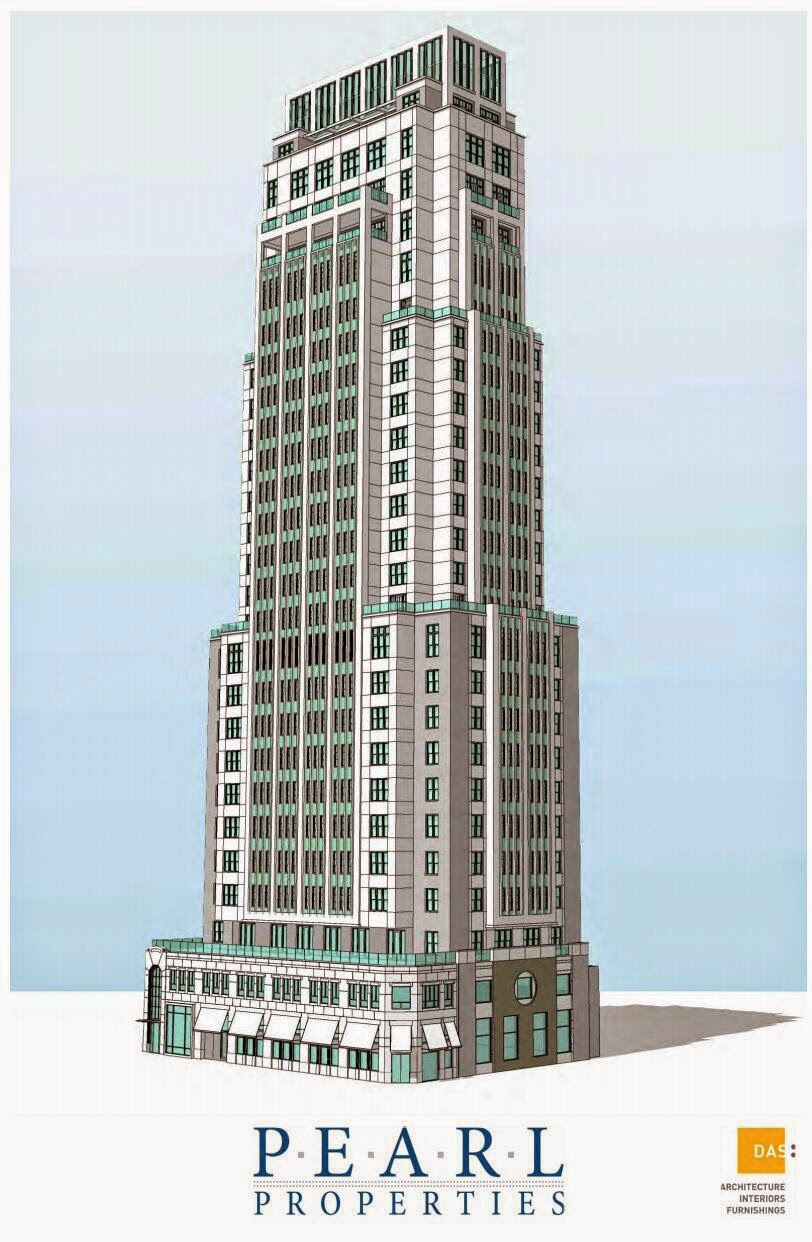
With the tragic loss of Philadelphia's last movie palace, the Boyd Theater on Chestnut Street, many were looking to Pearl Property's graceful rendering of an Art Deco tower flanking the corner as a concession.
Though only one rendering ever existed, the tower's handsome potential echoes an L.A. Noir embodiment that would have complement both the Boyd's lobby and its eastern neighbor.
So what happened?
That question can't be asked enough when it comes to the Boyd's fight, loss, and demolition. And unfortunately, that uncertainty continues even after the Boyd's auditorium is nearly gone.
Eimer Architecture, a firm that has never produced a building, let alone a high-rise for an address like Rittenhouse Square, has released a rendering that will be reviewed by the Historical Commission next week.
Inga Saffron had some choice words to say about it and, ever the critic, she couldn't be more correct. Like so many other high-rises, even townhouses, throughout Center City and University City, the tower's metal panels are the go-to decision for budget builders. They're a cheap way to make a simple building stand out.
But this is Rittenhouse-****ing-Square. Budget builders have no business here. It's bad enough when an architect puts a pig in a prom dress in New Kensington, but at 19th and Chestnut, it's not even economically necessary. Behind the revered Boyd, it's downright unethical.
Unfortunately there is a growing part of me that simply wants to move on. We lost the war for the Boyd, and there are worthy battles elsewhere. Eimer Architecture's building is uninteresting and flat, but it's now in the hands of the Historical Commission.
There are still curiosities, though. Namely, why did Pearl abandon its Art Deco tower, and why did it move the tower to Sansom Street? The answer to the latter is likely financial. For the project to have a low-rise retail component, Chestnut Street gets much more foot traffic. Still, it's irresponsible to the neighborhood and to the streets, and will likely leave quaint Sansom with a garage door and a blank wall.
Though only one rendering ever existed, the tower's handsome potential echoes an L.A. Noir embodiment that would have complement both the Boyd's lobby and its eastern neighbor.
So what happened?
That question can't be asked enough when it comes to the Boyd's fight, loss, and demolition. And unfortunately, that uncertainty continues even after the Boyd's auditorium is nearly gone.
Eimer Architecture, a firm that has never produced a building, let alone a high-rise for an address like Rittenhouse Square, has released a rendering that will be reviewed by the Historical Commission next week.
Inga Saffron had some choice words to say about it and, ever the critic, she couldn't be more correct. Like so many other high-rises, even townhouses, throughout Center City and University City, the tower's metal panels are the go-to decision for budget builders. They're a cheap way to make a simple building stand out.
But this is Rittenhouse-****ing-Square. Budget builders have no business here. It's bad enough when an architect puts a pig in a prom dress in New Kensington, but at 19th and Chestnut, it's not even economically necessary. Behind the revered Boyd, it's downright unethical.
Unfortunately there is a growing part of me that simply wants to move on. We lost the war for the Boyd, and there are worthy battles elsewhere. Eimer Architecture's building is uninteresting and flat, but it's now in the hands of the Historical Commission.
There are still curiosities, though. Namely, why did Pearl abandon its Art Deco tower, and why did it move the tower to Sansom Street? The answer to the latter is likely financial. For the project to have a low-rise retail component, Chestnut Street gets much more foot traffic. Still, it's irresponsible to the neighborhood and to the streets, and will likely leave quaint Sansom with a garage door and a blank wall.
Barely Human: Richard Prince
The world of art is a curious landscape. Once fraught with talent and skill, the 20th Century lowered the bar and it continues to sink into the mud. Still, history is full of crap. We only remember the best. Time will determine if anyone will remember Millie Brown's milk-vomit paintings.
And there's really nothing inherently wrong with producing crap and passing it off as art. If you're inventive enough to find a market of socialites willing to part with $100,000 for a shellacked turd, by all means. Passing a blank canvas off as a million dollar message about loneliness or waste or whatever doesn't make you a villainous person, it just makes you a hack, and your clients morons. The threshold for mediocrity is beginning to fade and audiences are slowly recognizing a desire for something, anything, better.
The true demons in the art world are those who can't claim to be artists at all. Let me introduce you to Richard Prince, if the internet hasn't already. This charlatan has been "re-appropriating" the artwork of others since the 1970s. In other words, he takes a photograph of a photograph, tweaks it a bit, and then claims it his own.
When Shia LaBeouf released a graphic novel by David Clowes as his own "original" movie, he was briefly exiled to obscurity, only to resurface with an apology he lifted directly from Yahoo! Answers. But despite what was either a misguided publicity stunt of just sheer stupidity, The Beouf was faced with the costly consequences of plagiarism.
Yet somehow Richard Prince has evaded the consequences of both plagiarism and a complete lack of talent for four decades. His most recent collection is "New Portraits," a title that is both boringly ironic and painfully unoriginal, featuring "original" screenshots from the Instagram feeds of talented and mostly nameless photographers.
What's almost as disgusting as Prince's blatant disregard for originality and his penchant for copyright loopholes is the fact that New York's Gagosian Gallery ran the exhibit for a month. Not only that, one was purchased for $90,000! His work has even been featured at and praised by the goddamn Guggenheim?! Honestly, what the fuck is wrong with people?!
And that is all bad enough to make Richard Prince perhaps the single worst person to weasel his way into the art world. Talentlessness, thievery, manipulation, and greed: these are all despicable traits. But what truly makes Richard Prince barely human is his undeserved ego and precise understanding that he is stealing. His own attitude towards his work is borderline sociopathic: "Copyright has never interested me."
Well, copyright isn't designed to interest thieves who molest the talented work of others and then capitalize upon it, it's to protect the victims from people like Richard Prince.
And there's really nothing inherently wrong with producing crap and passing it off as art. If you're inventive enough to find a market of socialites willing to part with $100,000 for a shellacked turd, by all means. Passing a blank canvas off as a million dollar message about loneliness or waste or whatever doesn't make you a villainous person, it just makes you a hack, and your clients morons. The threshold for mediocrity is beginning to fade and audiences are slowly recognizing a desire for something, anything, better.
The true demons in the art world are those who can't claim to be artists at all. Let me introduce you to Richard Prince, if the internet hasn't already. This charlatan has been "re-appropriating" the artwork of others since the 1970s. In other words, he takes a photograph of a photograph, tweaks it a bit, and then claims it his own.
When Shia LaBeouf released a graphic novel by David Clowes as his own "original" movie, he was briefly exiled to obscurity, only to resurface with an apology he lifted directly from Yahoo! Answers. But despite what was either a misguided publicity stunt of just sheer stupidity, The Beouf was faced with the costly consequences of plagiarism.
| The Thief |
Yet somehow Richard Prince has evaded the consequences of both plagiarism and a complete lack of talent for four decades. His most recent collection is "New Portraits," a title that is both boringly ironic and painfully unoriginal, featuring "original" screenshots from the Instagram feeds of talented and mostly nameless photographers.
What's almost as disgusting as Prince's blatant disregard for originality and his penchant for copyright loopholes is the fact that New York's Gagosian Gallery ran the exhibit for a month. Not only that, one was purchased for $90,000! His work has even been featured at and praised by the goddamn Guggenheim?! Honestly, what the fuck is wrong with people?!
And that is all bad enough to make Richard Prince perhaps the single worst person to weasel his way into the art world. Talentlessness, thievery, manipulation, and greed: these are all despicable traits. But what truly makes Richard Prince barely human is his undeserved ego and precise understanding that he is stealing. His own attitude towards his work is borderline sociopathic: "Copyright has never interested me."
Well, copyright isn't designed to interest thieves who molest the talented work of others and then capitalize upon it, it's to protect the victims from people like Richard Prince.
Wednesday, May 20, 2015
Lapstone & Hammer
Philadelphia's gay scene, although geographically small, is anything but a subdued presence. Despite its unofficial rebranding as Midtown Village, the rainbows - from street signs to neon rooftops - make it very apparent that Google Maps was correct in keeping it labeled the "Gayborhood."
But if you're a gay man who's ever lived in any other major city, you might be wondering why our Gayborhood seems solely fixated on local dining and nightlife. Sure, the bars and restaurants are fantastic, and many of them locally owned and operated by members of our LGBT community. Yet when it comes to shopping the streets of Walnut, 12th, or 13th, you're hard pressed to find fashion foreword clothing that isn't geared towards a 50 year old woman.
Not that there's anything wrong with that, and not that fashion forward men's clothing is geared exclusively towards gay men. And if you want to find a sexy outfit for Saturday night, Diesel and Urban Outfitters are on the other side or Broad Street paired appropriately with other prominent chains.
What's missing isn't the chains, though. Despite all the retail gripes about Center City's struggle to compete with King of Prussia and Cherry Hill, we have plenty of fantastic retail options otherwise found in suburban malls. But I'm not talking about Forever 21 and H&M. I'm talking about men's boutiques that offer unique and stylish options from obscure manufacturers. And most cities seem to have at least one, and it's usually where the gays dine and dance.
I still have a sweater I bought in D.C.'s DuPoint Circle more than fifteen years ago, it has yet to go out of style, and when I'm asked where I got it, I can proudly utter a name no one's ever heard of. And believe me, I'm a far cry from a Fashion Plate.
Over the years, Philadelphia's Gaybodhood has hosted a few unique men's boutiques. Sparacino's on 13th Street is largely regarded as the catalyst that ignited the street's retail prominence. Unfortunately Tony Sparacino passed away eight years ago. His legacy lives on in an annual scholarship aimed at LGBT art students, but his clothing store vanished.
In 2011, Matthew Izzo brought his New York boutique to Philadelphia's Gayborhood along with a wave of "Sixth Borough" transplants, later opening another in Old City. But as far as I can tell, his presence in Philadelphia is relegated to an online store. Around the same time the Philadelphia Home Art Garden, or P.H.A.G. ambitiously moved its knick-knack and card shop from its humble 12th Street location to a much larger space on Walnut, and began offering clothing and furniture. Soon after, P.H.A.G. shut its doors, and like Matthew Izzo, its presence was moved to the internet.
For many of these boutiques, particularly the latter two, it would now seem it was an unfortunate case of too much too soon. If you're a woman looking for champaign and shoes, your shopping options are a dime a dozen. But if you're a Center City man looking for a shopping experience, you've got to hoof it to East Passyunk's Metro Men's Clothing. But that's about to change, or apparently already has. Had Matthew Izzo and P.H.A.G. waited a few short years to expand, they might still be in the Gayborhood.
Lapstone & Hammer recently set up shop in the former City Blue near 11th and Chestnut. Likely following the trend of East Chestnut's transformation, Lapstone & Hammer is the kind of boutique that begs to be dubbed "artisan." If you're a man who wishes that Blake Lively or Gwenyth Paltrow had more to say about your fashion options on their blogs, Lapstone & Hammer is for you.
While it doesn't posses the same quirks and characteristics of the LGBT inspired men's boutiques that adorned our gay enclaves from the 80s into the early 21st Century, there is less reason for such businesses to exist. That's apparent in our Gayborhood's rapid evolution, as well as an enhanced market in urban men - gay or straight - no longer resigned to buying bags of white tube socks and Levi's from Kohl's.
On a side note, it appears that Lapstone & Hammer intends to restore the building's wild Vitrolite facade.
But if you're a gay man who's ever lived in any other major city, you might be wondering why our Gayborhood seems solely fixated on local dining and nightlife. Sure, the bars and restaurants are fantastic, and many of them locally owned and operated by members of our LGBT community. Yet when it comes to shopping the streets of Walnut, 12th, or 13th, you're hard pressed to find fashion foreword clothing that isn't geared towards a 50 year old woman.
Not that there's anything wrong with that, and not that fashion forward men's clothing is geared exclusively towards gay men. And if you want to find a sexy outfit for Saturday night, Diesel and Urban Outfitters are on the other side or Broad Street paired appropriately with other prominent chains.
What's missing isn't the chains, though. Despite all the retail gripes about Center City's struggle to compete with King of Prussia and Cherry Hill, we have plenty of fantastic retail options otherwise found in suburban malls. But I'm not talking about Forever 21 and H&M. I'm talking about men's boutiques that offer unique and stylish options from obscure manufacturers. And most cities seem to have at least one, and it's usually where the gays dine and dance.
I still have a sweater I bought in D.C.'s DuPoint Circle more than fifteen years ago, it has yet to go out of style, and when I'm asked where I got it, I can proudly utter a name no one's ever heard of. And believe me, I'm a far cry from a Fashion Plate.
Over the years, Philadelphia's Gaybodhood has hosted a few unique men's boutiques. Sparacino's on 13th Street is largely regarded as the catalyst that ignited the street's retail prominence. Unfortunately Tony Sparacino passed away eight years ago. His legacy lives on in an annual scholarship aimed at LGBT art students, but his clothing store vanished.
In 2011, Matthew Izzo brought his New York boutique to Philadelphia's Gayborhood along with a wave of "Sixth Borough" transplants, later opening another in Old City. But as far as I can tell, his presence in Philadelphia is relegated to an online store. Around the same time the Philadelphia Home Art Garden, or P.H.A.G. ambitiously moved its knick-knack and card shop from its humble 12th Street location to a much larger space on Walnut, and began offering clothing and furniture. Soon after, P.H.A.G. shut its doors, and like Matthew Izzo, its presence was moved to the internet.
For many of these boutiques, particularly the latter two, it would now seem it was an unfortunate case of too much too soon. If you're a woman looking for champaign and shoes, your shopping options are a dime a dozen. But if you're a Center City man looking for a shopping experience, you've got to hoof it to East Passyunk's Metro Men's Clothing. But that's about to change, or apparently already has. Had Matthew Izzo and P.H.A.G. waited a few short years to expand, they might still be in the Gayborhood.
Lapstone & Hammer recently set up shop in the former City Blue near 11th and Chestnut. Likely following the trend of East Chestnut's transformation, Lapstone & Hammer is the kind of boutique that begs to be dubbed "artisan." If you're a man who wishes that Blake Lively or Gwenyth Paltrow had more to say about your fashion options on their blogs, Lapstone & Hammer is for you.
While it doesn't posses the same quirks and characteristics of the LGBT inspired men's boutiques that adorned our gay enclaves from the 80s into the early 21st Century, there is less reason for such businesses to exist. That's apparent in our Gayborhood's rapid evolution, as well as an enhanced market in urban men - gay or straight - no longer resigned to buying bags of white tube socks and Levi's from Kohl's.
On a side note, it appears that Lapstone & Hammer intends to restore the building's wild Vitrolite facade.
Tuesday, May 19, 2015
Comcast, the CITC, and its place in Information Technology
In all the excitement surrounding Comcast's Innovation and Technology Center, it's easy to gloss over Comcast's original Center and regard it as old news. But the CITC's development, and what it means for Philadelphia, is more than just one tall tower that will outrank the likes of Atlanta and Los Angeles, it is also part of Comcast's sum total.
On its own, Comcast Center redefined Philadelphia's notion of Center City skyscrapers. With the exception of its northern neighbor, the Bell Atlantic or Verizon tower, Philadelphia's humble portfolio of true skyscrapers hug their sidewalks. On one block that could have easily housed Comcast's entire vertical campus, the cable giant decided to create a spectacle. Using a could-be footprint for another tower, Comcast opted for a grand plaza that breaks up the towering monotony of JFK Boulevard by creating a vantage point from which to admire Robert A. M. Stern's local masterpiece.
In a lot of ways, the theory echoes Mies van der Rohe's Seagram Building in Midtown Manhattan. As height restrictions led New York developers to step their skyscrapers back from the sidewalk in an effort to maximize every square foot, Mies van der Rohe decided to make a statement by "wasting" land on a plaza and designing a completely vertical skyscraper.
Likewise, Comcast's plaza makes its Center both humbling and intimidating, and in providing both, likely achieved the company's goal. It's easy to wonder why the CITC isn't a bit taller. Why is the roof shorter than Comcast Center? Why does the spire face west, and not the campus's core? They may seem irrelevant questions, but no one spends $1B on a building without analyzing every last detail.
Were the CITC taller, if its spire faced Comcast's plaza, its presence might overpower Comcast's corporate headquarters. Despite its academic rank as Pennsylvania's tallest building, the CITC is still second to Comcast Center and its plaza.
As the sum total stands, Comcast's vertical campus will be Philadelphia's best planned corporate park, at least in the West Market vicinity. With the exception of Independence Hall, the University of Pennsylvania's historic core, and a handful of other 18th and 19th Century projects, Comcast has set a new bar for future development.
However, what works aesthetically may not prove so practical, and it all hinges on Comcast's true plan for the CITC. As it is, Comcast is a telecom corporation, with only a very new and relatively small investment in information technology. IT companies throughout the Silicone Valley, the Cascade Valley, and the Dulles Corridor are comprised of sprawling campuses that look like high-tech universities.
While many of these corporations decided to set up shop in the suburbs for financial reasons, the reasons they've stayed are logistic. It's not as though Apple, Microsoft, and Intel can't afford to build their own vertical campuses in San Francisco, Seattle, or Portland, it's that they don't want to. And for good reason.
Comcast, despite its apparent desire to delve into IT, is still every bit as corporate as JP Morgan. Although Big Software plays the corporate game on the same trading room floor, their philosophy, operations, and corporate demographics are at odds with Comcast's 52 year old model.
The free spirited software geeks tethered to their iPads and laptops aren't tethered to their cubicles. IT's endless string of meetings is less the end result of corporate bureaucracy, but a place for collaboration and productive innovation. The IT campus is very much a hive, not a hierarchy of elevator banks that reserve the uppermost floors for a select few.
It will be interesting to see not only how Comcast fares in the unfamiliar world of information technology, but also how its vertical campus manages to support it. If it works, the CITC and Philadelphia will change the industry's game, proving that software and innovation can accommodate fixie saddled Millennials unwilling to commute or relocate to the Silicone Valley or King of Prussia. But Comcast's foray into innovation needs to be more than a building, a concept, and a vertical theory. First and foremost it needs to understand innovation, why software empires succeed, and why so many more come and go overnight.
Information Technology is not an industry that survives on the status quo. It is the modern and global embodiment of the first 40 years of the automotive industry. It's a technological revolution that refuses to peak. Profitable Big Software doesn't succeed through mergers and acquisitions, those are simply the end results of successes and failures. Comcast can't buy its way into Information Technology, rather it needs to understand that companies like Apple and Google thrive by way of true innovation and a market that continues to crave the next best thing.
On its own, Comcast Center redefined Philadelphia's notion of Center City skyscrapers. With the exception of its northern neighbor, the Bell Atlantic or Verizon tower, Philadelphia's humble portfolio of true skyscrapers hug their sidewalks. On one block that could have easily housed Comcast's entire vertical campus, the cable giant decided to create a spectacle. Using a could-be footprint for another tower, Comcast opted for a grand plaza that breaks up the towering monotony of JFK Boulevard by creating a vantage point from which to admire Robert A. M. Stern's local masterpiece.
In a lot of ways, the theory echoes Mies van der Rohe's Seagram Building in Midtown Manhattan. As height restrictions led New York developers to step their skyscrapers back from the sidewalk in an effort to maximize every square foot, Mies van der Rohe decided to make a statement by "wasting" land on a plaza and designing a completely vertical skyscraper.
Likewise, Comcast's plaza makes its Center both humbling and intimidating, and in providing both, likely achieved the company's goal. It's easy to wonder why the CITC isn't a bit taller. Why is the roof shorter than Comcast Center? Why does the spire face west, and not the campus's core? They may seem irrelevant questions, but no one spends $1B on a building without analyzing every last detail.
Were the CITC taller, if its spire faced Comcast's plaza, its presence might overpower Comcast's corporate headquarters. Despite its academic rank as Pennsylvania's tallest building, the CITC is still second to Comcast Center and its plaza.
As the sum total stands, Comcast's vertical campus will be Philadelphia's best planned corporate park, at least in the West Market vicinity. With the exception of Independence Hall, the University of Pennsylvania's historic core, and a handful of other 18th and 19th Century projects, Comcast has set a new bar for future development.
----------------
However, what works aesthetically may not prove so practical, and it all hinges on Comcast's true plan for the CITC. As it is, Comcast is a telecom corporation, with only a very new and relatively small investment in information technology. IT companies throughout the Silicone Valley, the Cascade Valley, and the Dulles Corridor are comprised of sprawling campuses that look like high-tech universities.
While many of these corporations decided to set up shop in the suburbs for financial reasons, the reasons they've stayed are logistic. It's not as though Apple, Microsoft, and Intel can't afford to build their own vertical campuses in San Francisco, Seattle, or Portland, it's that they don't want to. And for good reason.
![]() |
| Apple's upcoming Concordia campus |
Comcast, despite its apparent desire to delve into IT, is still every bit as corporate as JP Morgan. Although Big Software plays the corporate game on the same trading room floor, their philosophy, operations, and corporate demographics are at odds with Comcast's 52 year old model.
The free spirited software geeks tethered to their iPads and laptops aren't tethered to their cubicles. IT's endless string of meetings is less the end result of corporate bureaucracy, but a place for collaboration and productive innovation. The IT campus is very much a hive, not a hierarchy of elevator banks that reserve the uppermost floors for a select few.
It will be interesting to see not only how Comcast fares in the unfamiliar world of information technology, but also how its vertical campus manages to support it. If it works, the CITC and Philadelphia will change the industry's game, proving that software and innovation can accommodate fixie saddled Millennials unwilling to commute or relocate to the Silicone Valley or King of Prussia. But Comcast's foray into innovation needs to be more than a building, a concept, and a vertical theory. First and foremost it needs to understand innovation, why software empires succeed, and why so many more come and go overnight.
Information Technology is not an industry that survives on the status quo. It is the modern and global embodiment of the first 40 years of the automotive industry. It's a technological revolution that refuses to peak. Profitable Big Software doesn't succeed through mergers and acquisitions, those are simply the end results of successes and failures. Comcast can't buy its way into Information Technology, rather it needs to understand that companies like Apple and Google thrive by way of true innovation and a market that continues to crave the next best thing.
Sunday, May 17, 2015
Jim Cramer on Philadelphia
You know Jim Cramer? That loud guy from Mad Money who tells you when to buy and sell your stocks? Well, he's telling you to buy Philadelphia, and buy it now!
Cramer is a Philadelphia native, so it's understandable that he loves his hometown. But he also knows financial trends. That's why it's notable that on Friday he said, "If Philly was a stock, it would be incredibly undervalued."
Philly Bricks has been saying that for years, as has every other online cheerleader for America's most unappreciated city. But Cramer also made a significant point, essentially, we need to invest in our schools. Citing how Brooklyn managed to hold onto families by investing in the city's school district, the key to keeping Philadelphians downtown might be in making ours top notch.
Still, a city is more than the go-to demographics: new parents and Millennials. Sure, in a way they reinvented New York, put Portland on the map, and made a few people decide to live in Detroit. But catering to families and 20-somethings is also a flat approach. And that's where Philadelphia's affordability, proximity to New York and Washington, and its businesses - both established and emerging - come into play. And that seems to be where Cramer's assessment is really coming from.
The truth is, Cramer's endorsement isn't driving Philadelphia, it's a reaction to what's been taking place for about ten years. Philadelphia is coming into its own, perhaps for the third time in its history. Manhattan has become an island for the elite and Washington, D.C. has sprawled to West Virginia. Long forgotten and written off as an insignificant city, Philadelphia is both proving itself a worthy contender, but also one that can offer reasonably affordable housing for years to come.
People are taking note, and they aren't just recent college grads who can't afford more than a studio apartment. Big shots from New York, Chicago, and Boston are recognizing Philadelphia as a world class competitor and they're bringing their businesses with them. Why spend millions on corporate headquarters and a condo in Manhattan when all your employees are working from a WiFi connection anyway?
Buildings no longer make a corporation, and thousands of untold businesses are finding satellite offices in Philadelphia's home offices online.
Cramer didn't say as much but he certainly seems to get it. As stock, Philadelphia is undervalued. And savvy consumers are finally getting it too. Once ignored, and for a short time dubbed New York's Sixth Borough, Philadelphia is no longer playing second chair to anyone. From Comcast to Urban Outfitters, Center City to Phoenixville, we're playing the game and we're playing it right. Sure, we have our constraints, but business owners and residents are quickly learning to work with the system, instead of simply resigning ourselves to the mediocrity that the system breeds in isolation. And that's because we've finally recognized that Philadelphia is worth it.
I've said it before and I'll say it again: look out, New York, we're coming for you.
Cramer is a Philadelphia native, so it's understandable that he loves his hometown. But he also knows financial trends. That's why it's notable that on Friday he said, "If Philly was a stock, it would be incredibly undervalued."
Philly Bricks has been saying that for years, as has every other online cheerleader for America's most unappreciated city. But Cramer also made a significant point, essentially, we need to invest in our schools. Citing how Brooklyn managed to hold onto families by investing in the city's school district, the key to keeping Philadelphians downtown might be in making ours top notch.
Still, a city is more than the go-to demographics: new parents and Millennials. Sure, in a way they reinvented New York, put Portland on the map, and made a few people decide to live in Detroit. But catering to families and 20-somethings is also a flat approach. And that's where Philadelphia's affordability, proximity to New York and Washington, and its businesses - both established and emerging - come into play. And that seems to be where Cramer's assessment is really coming from.
![]() |
| Coming soon...and then some. |
The truth is, Cramer's endorsement isn't driving Philadelphia, it's a reaction to what's been taking place for about ten years. Philadelphia is coming into its own, perhaps for the third time in its history. Manhattan has become an island for the elite and Washington, D.C. has sprawled to West Virginia. Long forgotten and written off as an insignificant city, Philadelphia is both proving itself a worthy contender, but also one that can offer reasonably affordable housing for years to come.
People are taking note, and they aren't just recent college grads who can't afford more than a studio apartment. Big shots from New York, Chicago, and Boston are recognizing Philadelphia as a world class competitor and they're bringing their businesses with them. Why spend millions on corporate headquarters and a condo in Manhattan when all your employees are working from a WiFi connection anyway?
Buildings no longer make a corporation, and thousands of untold businesses are finding satellite offices in Philadelphia's home offices online.
Cramer didn't say as much but he certainly seems to get it. As stock, Philadelphia is undervalued. And savvy consumers are finally getting it too. Once ignored, and for a short time dubbed New York's Sixth Borough, Philadelphia is no longer playing second chair to anyone. From Comcast to Urban Outfitters, Center City to Phoenixville, we're playing the game and we're playing it right. Sure, we have our constraints, but business owners and residents are quickly learning to work with the system, instead of simply resigning ourselves to the mediocrity that the system breeds in isolation. And that's because we've finally recognized that Philadelphia is worth it.
I've said it before and I'll say it again: look out, New York, we're coming for you.
Labels:
Jim Cramer,
Mad Money
Luxury Healthcare
Have you ever walked into a pharmacy and wondered, "where's the panache?" Probably not. If you're like me, your trip to the pharmacy counter is a rare annoyance clouded in a fog of allergies. The only thing I've ever wondered about these places is why CVS bragged about eliminating cigarettes but still sells Cheesy Poofs.
But I digress.
There is apparently a small market that isn't quite satisfied with the service and atmosphere of the corner drug store, and if you've got an extra $2500 to $6500 a month, you can be a part of the circus.
New York's Cedra Pharmacy is taking pretentiousness to a new level with what it calls a "health concierge service." They won't just deliver your prescriptions, they'll send a chef to your house to help you cook and chaperone your trip to the grocery store.
The Grand package at $2500 a month will provide personal trainers, massages, and limousine rides to your doctor. The Select package, the one that could buy you a used Jetta every month, is reserved for cancer patients, just in case a victim has an extra $6500 a month after chemo bills.
I feel like there is probably some kind of reference to the nation's inefficient - and unequal - access to healthcare that could be made, but Cedra is so over the top of everything that makes sense, I wouldn't know where to possibly connect the dots. There's also the question of legality. Cedra claims it can change the flavor of your medication, even turn Viagra into a lollipop. I'm not expert on pharmaceuticals, but I have to imagine that the companies manufacturing medication have extremely strict guidelines on how and in what form its administered.
But where there's money there's always a way. This is all provided on behalf of New York's 1%, many of whom stood firmly against any form of universal healthcare on the grounds that they didn't want to pay for it. If Cedra has any hopes of selling these packages, it's pretty disgusting that anyone would be willing to spend thousands of dollars a month on tax deductible luxuries masquerading as healthcare, when there are millions still struggling with the Obamacare website.
But I digress.
There is apparently a small market that isn't quite satisfied with the service and atmosphere of the corner drug store, and if you've got an extra $2500 to $6500 a month, you can be a part of the circus.
New York's Cedra Pharmacy is taking pretentiousness to a new level with what it calls a "health concierge service." They won't just deliver your prescriptions, they'll send a chef to your house to help you cook and chaperone your trip to the grocery store.
The Grand package at $2500 a month will provide personal trainers, massages, and limousine rides to your doctor. The Select package, the one that could buy you a used Jetta every month, is reserved for cancer patients, just in case a victim has an extra $6500 a month after chemo bills.
I feel like there is probably some kind of reference to the nation's inefficient - and unequal - access to healthcare that could be made, but Cedra is so over the top of everything that makes sense, I wouldn't know where to possibly connect the dots. There's also the question of legality. Cedra claims it can change the flavor of your medication, even turn Viagra into a lollipop. I'm not expert on pharmaceuticals, but I have to imagine that the companies manufacturing medication have extremely strict guidelines on how and in what form its administered.
But where there's money there's always a way. This is all provided on behalf of New York's 1%, many of whom stood firmly against any form of universal healthcare on the grounds that they didn't want to pay for it. If Cedra has any hopes of selling these packages, it's pretty disgusting that anyone would be willing to spend thousands of dollars a month on tax deductible luxuries masquerading as healthcare, when there are millions still struggling with the Obamacare website.
Subscribe to:
Posts (Atom)