The township has been firm. Unless Richard Yoon's petition to the Supreme Court makes waves in Cheltenham, the owner of The First Korean Church will not be able to operate the property as a tax exempt church or school.
Currently Yoon pays over $130,000 in taxes yearly, and he'll likely unload the property if its tax status doesn't change.

Cheltenham is a nice enough suburb, but it isn't as renowned and cash flushed as other areas. Portner has a job to do, and losing $130,000 every year isn't part of it. In that regard, Portner's stance may seem reasonable.
It's a shame, because Lynnewood Hall is one of the regions most spectacular examples of Gilded Age architecture. Designed by Philadelphia's own architect to the stars, Horace Trumbauer, Lynnewood is the ninth largest historic home in the United States, 5000 square feet larger than Newport, RI's Breakers.
We learned our lesson when Whitemarsh Hall was demolished in the 1980s, the third largest historic house in the United States. When La Ronda was demolished a few years ago, preservationists and historians across the country were devastated, yet Addison Mizner's Spanish style masterpiece pales in comparison to Lynnewood Hall.
Enough locals don't realize what's at stake here. Landmarks like Biltmore Estate are household names, even for those with no interest in architecture or history. I know I don't need to say this to anyone reading an architecture blog, but that's what Lynnewood is.
It's City Hall. It's the Philadelphia Museum of Art. It's Philadelphia's foremost example of Gilded Age architecture, perhaps even the Northeast's.
If Portner wants something "magnificent," he already has it.
Beyond the rusted gates of Lynnewood Hall, Cheltenham has something even more magnificent, something no other region in the country can claim.
Lynnewood Hall is not alone. As stately as the manor is in itself and its grounds, it's simply one part of a complex of architecture history unrivaled in the United States, all of which lie dormant.
Across the street from Lynnewood Hall is not one Gilded Age mansion, but three.
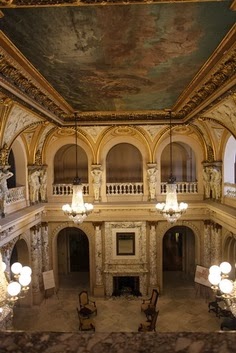
Elstowe Manor, the seventeenth largest historic house in the United States was abandoned in June of this year. Known as the Elkins Estate, the grounds are comprised of Elstowe Manor and Chelten House. Additionally, Georgian Terrace was abandoned by Temple's Stella Elkins Tyler School of Art a few years ago, also empty.
Fortunately none of these properties have succumbed to the death of architectural hope otherwise known as tax delinquency, but with the Elkins Estate taxed at more than $300,000 a year, it's even less likely that the township will grant any of these properties the exemption they need to survive much longer.
As if the architectural significance of these properties isn't enough, their history is unparalleled. All built for the Widener and Elkins families, these estates once carved out a private enclave for the tycoons that built the Philadelphia we know today. It's inarguable that their contribution to the region, even the nation, deserves the dignity of salvation.

When you consider this site's significance and the unique fact that this compound remains intact, Portner's position goes beyond the scope of his local responsibility, but also taps an obligation to the nation. While this land could stand to profit from townhomes and condos, this is one of those rare occasions when money doesn't matter.
What's most disconcerting is Portner's absent resolve for a specific outcome. This leaves the preservation community and the region in the dark. These properties are more than simple homes and the township has an obligation to responsibly address these assets as the benefits to the community that they are.
Without the township fielding investors, it leaves the job up to preservationists and realtors. But without a statement from the commissioner other than it should be "something magnificent," those concerned about the fate of these mansions can do little.
Can it be a school? Can it be converted into condos? Can it be a museum?
No one knows.
Without an interest from those in charge, realtors and property owners are saddled with finding buyers willing to use the properties as they were zoned. In the case of Lynnewood Hall, that's as a private home, which at 70,000 square feet, is a tough sell in Cheltenham Township.
Cryptic comments from those presiding over the nation's most significant chunk of unused real estate call their motives into question. Sadly, the most realistic possibility is one that happens all too often.
Could Harvey Portner simply be awaiting the inevitable, wherein property owners unable to sell simply abandon their tax obligations, allowing the mansions to be seized by the township and sold for scrap?

