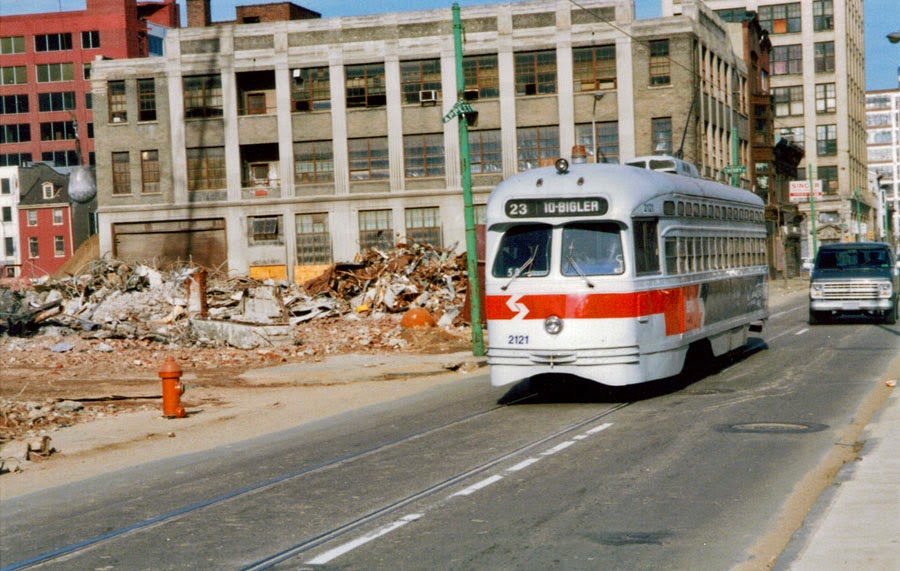
Showing posts with label Furnished Room District. Show all posts

Wednesday, February 25, 2015

Sigma Sound Studios

The Sound of Philadelphia is coming down to make way for Carl Dranoff's towering SLS International Hotel and Residences on South Broad Street. Philadelphia International Records was definitely a Philadelphia institutions, and an American one. But uptown in a forgotten pocket of Center City, perhaps the last pocket to be terraformed by new condos and hotels, Sigma Sound Studios is also no-more. 

BizJournals has the skinny.

The small building that gave us Macho Man and Disco Inferno, the latter a song that never seems to end, has been sold and will be converted into apartments. It isn't clear yet whether the building will simply be renovated, grow, or like the Sound of Philadelphia, demolished for something larger. Sigma Sound Studios isn't a huge building, and in an emerging neighborhood literally steps from City Hall, its redevelopment would likely profit from additional space.

This neighborhood - the place I've called home for almost eight years - is a unique one. It's long-gone warehouses once housed films from studios like Warner Brothers and MGM throughout the 30s, 40s, and 50s. But throughout much of the 20th Century, it was also a notorious red light district. Rumor has it, in the early 20th Century, sailors docked on Delaware Avenue were forbidden from walking the streets of what was often called the Furnished Room District, so named for its abundance of flop houses, brothels, and drug dens. 

As late as the early 2000s, XXX book stores occupied Arch Street and loosely named "massage parlors" still play a part in what's left of a neighborhood clinging to its seedy past. Likely because of its history, the district bound by Broad, 11th, Market, and Vine was targeted for reconstruction in the 70s, 80s, and 90s. Unfortunately its history - the good, the weird, and the untoward - has been scraped from the historical narrative of Philadelphia with very little record. 

While I'll miss my cheap rent and a garden a stone's throw from City Hall, it will be exciting to see how the neighborhood evolves and how its unique inhabitants choose to remember it. Wedged between the Convention Center and the growing Loft District, change was inevitable. Hopefully it won't soullessly embrace the convention center but also retain a little bit of its heart, however jaded. Things in Philadelphia tend to do just that.

Sunday, June 15, 2014

The Other Disney Holes

The Disney Hole at 8th and Market, a surface parking lot once home to Gimbels and the proposed site of a DisneyQuest indoor amusement park, has been a black eye on Market East's already battered face for decades. But in a city that has more parking than it knows what to do with, it isn't Center City's worst example of poor planning that defaulted to the status quo of urban real estate: surface parking.

In the 1980s, when loft living was more akin to starving artistry than wealthy yuppies, the area north of Arch Street between 11th and Broad looked a lot like Old City. It was packed with underutilized warehouses, some providing cheap housing and office space, others vacant. Interspersed with worthless trinity homes, modest row houses, and ample parking, blocks and blocks were razed for the Pennsylvania Convention Center, the Vine Street Expressway's extension, and a Market East Station that allowed trains leaving Suburban Station to connect directly to the Northeast.


Unfortunately these shortsighted projects failed to recognize the potential future of Center City and the neighborhood once referred to as the Furnished Room District. At the time, Market East was lined with triple X theaters and this neighborhood was the backwater of Philadelphia's sex industry. The collateral damage was welcome, a neighborhood so disdained that little history was ever even recorded. Many buildings demolished without the posterity of a photograph.

The Pennsylvania Convention Center, despite its woes, did pull this neighborhood up. Reading Terminal Market has handsomely reaped the rewards. But its attractions and hotels cater to those who come to the city in cars, and the equal and opposite reaction to the area's success has been the Disney Holes along Vine Street that continue to chip away at what's left.

Vine Street has been a wide avenue since the 1930s, and has long since detached Callowhill from its right to truly call itself Center City. It was likely perceived that the Vine Street Expressway would be no worse. But a lack of insight and a loathing for the Furnished Room District allowed urban planners to not only introduce a freeway, but also widen Vine's existing surface streets, requiring more demolition along the east bound lanes leaving blocks too narrow to truly develop.


It was a dumb move. Interstate 676 was specifically designed to relieve crosstown traffic on Vine Street. If anything, Vine's surface components should have been narrowed. The street rarely sees the need for its six lanes and those who use it as an exit ramp to New Jersey speed. And for reasons I'll never quite understand, most Jersey bound traffic tends to use Race Street to connect to the Ben Franklin Bridge.

But as the city continues to grow, defying a post-recession logic, little has been said of Center City's final frontier. Have those in City Hall been in office so long that they still turn a blind eye to a neighborhood they fought so hard to erase? Lavish master plans have been proposed to connect Center City and the Delaware River, the Ben Franklin Parkway is still improving, and plans have been proposed as far north as Strawberry Mansion. Why has the Furnished Room District, two blocks form City Hall, been ignored?

Some have suggested capping the Vine Street Expressway, among other things. All fine ideas, but none have gotten attention from those who could make it happen. When you consider the fact that the improvements at the Pennsylvania Convention Center are already beginning to resonate, it seems even odder that this neighborhood remains forgotten. These parking lots are about as relevant to City Hall as those surrounding the Stadium District. 

And perhaps that's why. The state foolishly failed to provide any designated parking for the Convention Center and these lots wildly profit as necessary evil. The center even advertises them. All thirty six of them. Yes, thirty six. Thirty six parking lots and garages that the Pennsylvania Convention Center advertises on its website, not one owned by the Pennsylvania Convention Center.


Perhaps soon the center will find enough money to cap its Race Street facade with its own garages. It has the room, and the space would generate money. Can you imagine that? A Pennsylvania Convention Center free from the confines of the Carpenters and Teamsters, with a can't-beat downtown location, and its own designated parking? Wow.

But I digress.

More hotels are coming. Once the last surface lot on Arch Street disappears, hotels will find themselves on North Broad Street, Race Street, and ultimately development will begin to replace the Disney Holes along Vine Street.

The city needs to get out in front of the progress and tackle Vine Street now. Change is happening and it's happening fast. Designating street parking on Vine Street and narrowing each side to two lanes would dramatically slow down traffic, improve pedestrianization, and expand the footprint for potential development. 

Vine Street may not even need to be capped to pull Callowhill closer to Center City. Many cities have highway trenches running through their cores, and those that succeed without a Big Dig succeed because they're surrounded by dense development. Let's start enticing that development with a better Vine Street and finish what the city started thirty years ago. 


Tuesday, December 21, 2010

Moonglo Hotel and Supper Club

The former Furnished Room District - roughly defined between Broad and Chinatown, and Market and Vine - was once the site of a very unique nightlife scene. Bars, supper clubs, and small hotels dotted the streets of Center City's industrial zone. Between factories and warehouses, in the shadow of the Reading Viaduct, in older row homes were the businesses that entertained the district's employees.

Construction of the Pennsylvania Convention Center and the Vine Street Expressway was responsible for the demolition of most of the more reputable businesses. Some of the seedier theaters and bookstores remained into the 90's, the most recent being demolished for the expansion of the PCC.

The Moonglo Hotel and Supper Club is shown here in 1961. On the northwest corner of Race and Juniper, it is currently the site of a surface parking lot.

Monday, November 1, 2010

The Trocadero

The Arch Street Oprah House, better known as The Trocadero Theatre, or simply "The Troc", opened in 1870 and was designed by Edwin Forrest Durang.

1960

It's various incarnations include The Arch Street Opera House, Park Theatre, New Arch Street Oprah House, Continental Theatre, Gaiety Theatre, Casino/Palace Theatre, Troc Theatre, Slocum's and Sweatman's Theatre, Sweatman's Arch Street Opera House, Simmon's & Slocum's Theatre, and Simmon's Theatre.

1973

Over the years the Trocadero has hosted plays, vaudeville shows, and burlesque. It played a prominent roll entertaining traveling businessmen and military personnel during Chinatown's colorful history as the city's vice district, complimenting nearby opium dens and the adjacent Furnished Room District and Tenderloin.

The Trocadero today

Its most recent use was established in 1986 as a concert and dance venue.

Tuesday, October 26, 2010

The Furnished Room District and Tenderloin

For decades Philadelphia hosted two of the nation’s most notorious red light districts. Bound by North Broad Street, Market East, Chinatown, and including a wide and industrial stretch of Vine Street prior to the construction of the chasm that now segregates Center City from Callowhill, the Furnished Room District surrounding Reading Terminal and the Tenderloin to the north made up a den of iniquity so lewd that sailors docked in Philadelphia were forbidden from walking its streets.

This post-industrial fallout of large warehouses and rundown hotels used as flophouses housed the city’s homeless, drug addicts, and prostitutes. Chinatown hosted the city’s opium dens and burlesque houses, including The Trocadero, and its eccentric inhabitants called the Furnished Room District and Tenderloin their home.

View of the Furnished Room District and Reading Terminal from atop City Hall

The Furnished Room District's sex themed history spanned a century, with two adult bookstores still occupying the corner of 13th and Arch until the last decade. While the last sordid businesses lingered into the 21st Century, city planners began chipping away at this neighborhood’s infrastructure in the 80’s and 90’s.

12th and Arch in 1917

Following The Gallery, the relocation of Reading Terminal’s trains to a new Market East Station required the demolition of several blocks of Chinatown to accommodate underground rail tunnels. While moving the trains underground eliminated the need for the noisy elevated Reading Viaduct, it left Chinatown scarred with a number of large surface parking lots.

1311 Filbert - 1911

During this transition phase, the Furnished Room District became a refuge for Bohemia. Artists and punks occupied the apartments above the remaining storefronts. Nightlife in the district was limited to several small bars including Pentony Tavern which was a gay bar on Filbert Street, several adult themed bookstores, and rampant prostitution. David Lynch lived in the Tenderloin at 13th and Wood in the early 1970's and wrote of it, "Philadelphia, more than any filmmaker, influenced me. It's the sickest, most corrupt, decaying, fear-ridden city imaginable. I was very poor and living in bad areas. I felt like I was constantly in danger. But it was so fantastic at the same time."

Breintnall Building's Adult Entertainment Center in the 1990s

The Vine Street Expressway drove a wedge between the district’s hotels and residences and The Tenderloin to the north. It called for the demolition of almost every building on the south side of Vine Street, leaving a street scape lined with narrow parking lots.

While transportation improvements left the Furnished Room District and Chinatown to suffer, the blocks behind Reading Terminal were chosen for the Pennsylvania Convention Center, requiring an expansive clearing of the district’s original architecture. At the same time, politicians were eying Chinatown’s northern annex as the location for a new baseball stadium and had planned to run an expressway exit right through its heart.

Chinatown's Trocadero in 1978

These two proposals were successfully blocked by neighborhood opposition but by then Chinatown had been boxed in by several large civic developments: the Convention Center, The Gallery and bus terminal, The Vine Street Expressway, and a sea of surface parking lots west of Franklin Square.

Near 12th and Race - Demolition for the first phase of the Pennsylvania Convention Center

The final phase of the Convention Center, currently under construction, cleared most of the remaining architecturally significant and historic representations of the Furnished Room District’s eclectic buildings including the Race Street Firehouse, The Lithograph Building, the Metzger Building, and a number of others.

Today, very little remains of this once infamous neighborhood. By targeting blight and ignoring architectural significance, developers have managed to completely erase an entire neighborhood and thus, its history. A small strip of industrial buildings have been restored along the 1200 block of Arch Street and a handful of industrial and small row houses are still maintained on and above Race between 11th and Broad.

12th and Arch in the 1970s

A portion of the original Tenderloin lives on as Callowhill and Chinatown’s northern annex, sometimes called the Loft District, or Eraserhead by cinema buffs who pay homage to the inspiration of David Lynch's movie of the same name, inspiration that is now a U-Haul parking lot. Meanwhile in the former Furnished Room District, very little movement has been made to develop what remains. Aside from the Convention Center, the district now mostly consists of poorly maintained surface parking lots.

Such projects often attract chain restaurants and retail establishments that cater to tourists and conventioneers and one can hope that it will attract these businesses to the area’s arterial streets such as North Broad and Market East. Unfortunately the Convention Center’s north side pays no respect to what remains of its original architecture. With a wide overhang supporting a garage used to park utility vehicles, its narrow sidewalk devoid of trees; it doesn’t encourage the kind of growth that surrounds most American convention spaces. It remains to be seen if the Convention Center will attract the kind of business the state once promised.