Sunday, September 15, 2013

Center City's Trollies: Staying or Going?

Public Relations Supervisor for the Philadelphia Streets Department, Keisha McCarty-Skelton reported to Philadelphia Weekly that the 11th and 12th Street trolley tracks would be paved over or removed as part of the department's improvements to Center City's streets.

The lines haven't been actively used since the 1990s. While many nostalgic Philadelphians, myself included, would love to see street cars carrying passengers throughout Center City, the rails pose a headache to cyclists and motorists alike. The trains themselves pose an even bigger headache.

As buses can dive cleanly in one of two lanes, pull off to the side at stops, trolley cars tend to bumble down narrow streets like slowly rolling boulders. A stalled bus can be pulled to the side or towed away. An inoperable trolley car on 11th or 12th could gridlock an entire neighborhood.


Well, it looks like we're stuck with them whether we like it or not. McCarty-Skelton retracted her statement to Philadelphia Weekly having received incorrect information from an engineer. The Streets Department will be paving around the tracks. She pointed out that because the tracks are SEPTA's property, the Streets Department has no authority over them.

It's not clear if the Streets Department has attempted to work with SEPTA to remove the tracks other than quoting the cost of $400,000 per block, including both repaving and removal of the tracks.

SEPTA's trolley service on 11th and 12th is only technically suspended and not permanently closed. With SEPTA's sizeable investment from state and federal agencies, it's likely the cost of removing the tracks would be in a lengthy battle with authorities outranking the city's Streets Department.


In the meantime, those longing for the clang of the trolley echoing throughout Center City can remain hopeful that the possibility of downtown lines isn't completely dead.

No one on behalf of SEPTA has spoken out on the condition of its Center City trolley tracks and cables, or if it's even possibly to operate one on either the 11th or 12th Street lines.

Headaches and all, it would be impressive to see an occasional trolley operating on weekends and holidays, particularly on 11th and 12th Streets where it would be highly visible to tourists at Reading Terminal Market, perhaps adding another layer of (for lack of a better word) whimsy to Market East.

Friday, September 13, 2013

The Baltimore Avenue Camel

Omar Blaik of U3 Ventures brought his Baltimore Avenue project to the community with a novel concept: Ask the community what they want. 

Of course this idea is only novel in its ability to leapfrog a community that will inevitably beg the question, "well are you happier with nothing at all?"

The concept isn't new, and Blaik's use of it is likely more psychological than it is an attempt to truly field community opinion.  

It's still risky. 

We employ professionals for a reason: urban planners, architects, developers. When we hire amateurs to design we wind up with The Homer.


When a group of people who have nothing in common other than free time and something to complain about collaborate, we wind up with something known as a "camel," or a horse designed by a committee.

Parks & Recreation poked fun at urban planning with an example of the camel, when a group of city employees and "concerned citizens" all pitched in to design a mural. This is what happened.
Of course Blaik also risked never seeing his camel. Anyone who's ever been to a community meeting knows what kind of people would jump at Blaik's offer.

They're not fun people. 

They also don't work quickly. People who have time to go to community meetings have time.

In Inga Saffron's article on the subject, she cites the program established a decade ago by PennPraxis to develop a cohesive plan for the Central Delaware Waterfront as a nod to this type of community involvement, but fails to emphasize that it was developed a decade ago. 

Where are we with that?  

The Central Delaware Waterfront isn't a cohesive collection of neighborhood input and rainbow farts. In fact, it's just as bad as it's always been. Hell, the communal organization that rallied around PennPraxis can't even decide on a master plan. Instead they hold a yearly "show us your cool rendering, everyone" contest, piss away a few hundred grand, and maybe hang a new banner on the west end of their aerial tram to nowhere.

The only changes that have taken place on the Central Delaware Waterfront in the last decade are where developers have managed to defy the Motley Crue of amateur urban planners that run it.

SugarHouse and Waterfront Square sit fortressed from the city behind gates and parking lots while the amateur planners someone decided to put in charge continue to shoot down respectably integrated midrises that don't jive with the organization's nonexistent master plan. 

That's what happens when you put concerned citizens in charge. That's why we have professionals. The Central Delaware Waterfront will be lucky if it ever sees its camel.

Fortunately for Blaik, his experiment in community involvement will just land him with some boring townhouses. He's a developer and primarily concerned with making money, so he's not going to sit around and push paper like a city planner.

U3's Horse
What's disconcerting is the notion that this concept should be the future of urban planning. How can you expect more than the lowest common denominator when you ask a group of nurses, students, teachers, auto mechanics, military retirees, and housewives to design and plan a building? 

Of all people, our more artistic critics should see the potentially bland skyline of a city designed by a collection of its residents, instead of those schooled in design.

Could you see something designed by Frank Furness or Erdy-McHenry offered up on the chopping block of a town hall discussion?

Obviously community involvement is important, and our neighborhood coalitions do a fine job routinely reminding us just how involved they are in dictating creative control of our cityscape. 

That leaves our creative critics to address the need for exciting design that might not always appeal to absolutely everyone, advocating on the part of architects and artists with, "love it or hate it, you'll learn to live with it." 

Tuesday, September 10, 2013

AOL and the Future of Comcast

Bradley Maule of Philly Skyline is back, now writing for Hidden City Philadelphia. With him come the memories of a Philadelphia circa 2005 when everyday we'd eagerly turn to his own website, Philly.com, Brownstoner, or Inga Saffron's Blogger page, anticipating the seemingly daily proposals for new skyline changing high rises.

Maule has ignited speculation that Comcast and Liberty Property Trust have revisited plans for 18th Street, possibly employing London's Foster + Partners, responsible for 30 Saint Mary's Axe and Hong Kong's HSBC Building, among many other modern marvels.

Liberty Property Trust owns both sites on 18th Street between JFK and Arch, formerly the proposed sites of the American Commerce Center and Comcast's annex mirroring Suburban Station. For now, this seems to amount to little more than speculation stemming from Liberty's ownership and Comcast's impressive cover letter.

While Comcast has seen record growth, particularly since it's acquisition of NBCUniversal two years ago, many are questioning the cable (now media) giant's viability in a variety of industries already experiencing massive technological shifts.

There's no doubt that Comcast has the money to employ Foster + Partners and the blind ambition to set a few more local construction records. But their corporate business model may be primed to go the way of AOL.

"What's that, Wes? You're crazy." said everyone.


Well, first of all, AOL is far from dead. It exists as a collection of media outlets that you likely don't realize you visit all the time. But as a visible force in the technological realm, it is no longer a unified entity to be reckoned with.

The company that once dominated internet technology was forced into decades of "right sizing" when the industry they owned - dial up and highly proprietary internet access - disappeared over night.

Once poised to introduce us to the future of the internet and media, AOL was experimenting with dozens of new technologies and integrated media only coming to fruition today.

Before companies like Google took the reigns by releasing new, experimental technology, even risking the release of hackneyed ideas like Google Glass, AOL played it safe, put AOLTV in the closet, and chose a speculative business model despite their proven technological merit, and continued to buy, buy, buy.

AOL grew to the point that shareholders usurped the roles of internet revolutionaries and the company that put the world online from a garage in suburban Honolulu became synonymous with Oldsmobile.

Now is it sounding more familiar?

Comcast is still largely rooted in cable and it's recent investments are in traditional media. Like AOL customers who began peeking outside their Buddy Lists and Chat Rooms to explore what the world wide web had to offer, Comcast customers are exploring a vast world of media outside the confines of their cable boxes.

While Comcast continues to push bundles, forcing customers to purchase networks peddling Babies Having Babies and HSN just to get NBC and Fox (and still pushing landline service as something marketable), younger consumers are opting out of traditional television for internet entertainment.

Comcast seems to think their customers won't find anything they like, and likely thinks it shouldn't matter. After all, it's hard to access the internet without Comcast, especially in Philadelphia, right?

Wrong.

Technology and access to interactive media seems to be changing too fast for the dinosaurs at 18th and JFK to grasp. In fact, it's changing too fast for many of us over thirty-five. Not only is a younger generation watching their television shows without a television, they're accessing the internet and all it offers without a computer. And that's where Comcast's reign begins to falter.

While many interact with media on smart phones and tablets, accessed through Sprint, T-Mobile, and Verizon, the media their accessing is even less traditional, and often less corporatized.

Comcast seems to think its ace in the hole is in their acquisitions of mainstream media like NBCUniversal, while younger audiences are finding their entertainment on College Humor and Cracked.com and getting their news from BuzzFeed and privately run blogs.

You don't even need to be a Millennial to see the trend changing. A decade ago you likely wouldn't have met a person who didn't have several hundred channels cabled into their idiot box. Today you may only know a few.

Even if they are Comcast customers, much of people's viewing choices come from Netflix and Hulu where they can not only watch what they want when they want, but even watch original programming like Season 4 of Arrested Development and Orange Is The New Black which aren't even available on cable.

This rogue programming is often arguably better than standard programming because they're offered with less censorship, no network involvement, and are produced without the time constraints of the half hour sitcom or one hour drama.

Plus, and this is even more detrimental to the traditional cable programming business model, these programs are seemingly commercial-free because the advertising is imbedded in the application rather than interrupting the program. More and more people are willing to sit through a 30 second commercial to watch a three minute clip on YouTube, and advertisers are taking note.

If Comcast was smart, they would have bought Tumblr and Demand Media, not NBCUniversal.

It's hard to say if Comcast will ever choose to tap into this market. As Google begins to rollout Google Fiber, offering access 100 times faster than broadband, Comcast is saying we can't handle it and TimeWarner says we don't want it.

This may say little about the programming Comcast and TimeWarner offer, or the platform on which it's offered, but it says a lot about their corporate impression of the market place. 

These are the words of a monopoly. Of Walmart.

In fact, the cable industry has been lobbying Capitol Hill for the right to control how much of the internet their customers can access. Instead of joining the new media, cable providers are trying to block it. Like a cranky aunt with tight parental controls, Big Cable wants to restrict our viewing to serve their corporate interest.

Who knew allowing the sale of NBCUniversal to a company that controls which networks we access would have been a conflict of interest? Oh, just everyone.

But even if the cable industry succeeds in restricting Hulu and Netflix to serve themselves, market trends are dictated by the newest markets, markets these corporations don't seem to understand. These consumers already know where to find the content they want, and if they can't get it within a cable company's pre-packaged internet bundle, they'll find it on YouTube or download it from Russia.

And again, it doesn't matter because they're not watching television from a big screen TV in the living room, they're watching FunnyOrDie.com on the subway.

It's a new frontier.

These are consumers who got tired of Lady Gaga after a one year hiatus, despite her cult like following seemingly ages ago. To them, Google Fiber is Katy Perry and Comcast is Steely Dan. A laptop tethered to Comcast might as well be a big plastic Garfield phone.

If a technology company can't recognize that its market wants the newest and best, no matter how slightly newer or better, how will it ever be able to compete with the rogue, unpackaged entertainment within the Wild West of the internet, gaining more and more traction by the minute?

Barnes and Noble learned this from Amazon, and the retail industry learned this from everything from eBay to Overstock to CraigsList. Comcast, perhaps under the impression that access to the internet is somehow synonymous with the internet, ignored the memo.

As an amateur architectural buff with a vested interest in technology and our virtual environments, I only hope that Liberty Property Trust and Foster + Partners get to work on North 18th Street before Comcast's shareholders recognize exactly where they're headed.

Sunday, September 8, 2013

Christo and Jean-Claude: Reclaiming Mother Nature's Masterpiece

I love big cities, the built environment, mind bending feats of modern technology, mammoth bridges that disappear into the horizon, cruise ships that scrape the top of the Miami skyline.

You know what's even more amazing? The exact opposite of all of that.

Natures wild prowess, its unrelenting strength, and its ability to completely eradicate the most monstrous of our creations.

Standing atop the Empire State Building proves the marvels of human engineering, but what's humbling is the view across the city and beyond, displaying the curvature of a wild planet that refuses to be tamed.

For years, artists Christo and Jean-Claude dreamed of draping Mother Nature's masterpiece in a drag queen's gown along six miles of the Arkansas River in Colorado. While Christo's website calls the project temporary - lasting only two weeks - he conveniently leaves out the two years it will take to construct.


I find outsider art interesting. In a genre of boring canvases and abstract nonsense, modern art rarely inspires me. But when it interacts with the environment, it often elicits an emotional response. Christo and Jean-Claude's The Gates of Central Park offered a bit of whimsy, contrasting the green backdrop of an urban oasis. Whether or not you consider The Gates art, its place was appropriate for the installation.

Likewise, Olafur Eliasson Waterfalls - while they certainly looked better on paper - were unique, and the concept fitting against the backdrop of the Manhattan skyline.


At best, the community in which they were installed applauded the artwork. At worst, New Yorkers found them a hackneyed studio prop that was at least clever. Whatever the community's opinion, their placement didn't really offend anyone because public art installations - good or bad - complement urban environments full of skyscrapers, towering bridges, and billboards.

One could even say that Christo and Jean Claude's The Gates and Eliasson's Waterfalls drew an environment of urban cynics into the nature they've forgotten. By offering a path into the woods, The Gates led urbanites to a forgotten forest while Waterfalls reminded New Yorkers of nature's mighty ferocity just upstream.


However, Christo's On The River does just the opposite. Instead of respectfully returning us back to that from which we're from, his project vandalizes our origins, our natural beginnings. And for what purpose?

Visitors come to New York for the architecture, the theater, the art. New Yorkers live there for the excitement, the careers and opportunities, and endure what can at times be a frustrating feat of human endurance with little reprieve. The same can be said for all cities.

But aside from the obvious, the differences between these two environments - the chaos we've built and the nature that rejuvenates us at our core - aren't completely parallel. We aren't rooted in urbanity. Spiritual solace cannot be found in Central Park, even with some orange flags as our guide. 

Not far from our nation's Northeast Corridor, we are a people who've embraced our natural reserves, painstakingly preserving some of the world's most spiritual natural wonders.

There's a reason we don't build a Walmart within Yosemite National Park or put condos in the Grand Canyon, and for the exact same reasons, the Arkansas River in southern Colorado is protected from development, however temporary or small.

Although Christo is attempting to get the proper permits, his project is just as principally disrespectful as Sean Parker's illegal $10M fairy tale themed wedding in Big Sur, California. We leave only footprints, not rivets and I-beams.

His urban installations are often bankrolled by municipalities who know they'll see a surge in tax revenue. Christo has convinced himself that city bureaucrats shell out millions to wrap their landmarks and bridges in cellophane as if they're something far greater than a business tactic or tourist trap.

Unfortunately, there's a two dimensional divide between the international art community and those opposed to the project. While the implication, "we don't want you here," may be true, it's far from trite. 

Those opposed to the project are not inherently unappreciative of art simply because they don't want Christo's work here. Likewise, those who support Christo's work aren't eagerly awaiting the destruction of this natural oasis.

On The River belongs atop the Vine Street Expressway, or any freeway canyon in the nation for that matter. There his message could echo that of The Gates, symbolizing to harried commuters a river and reminding them of the nature we replaced with our concrete jungles.

What does Christo's On The River state? What is his message? And most importantly, as an artist who design installations intended to compliment the environment and community in which they reside, who is his audience?

Will the urban art appreciator who flies to southern Colorado to see Christo's work stay long enough to explore Salida and Cañon City, it's peaceful nature, and appreciate Mother Nature's masterpieces? Or will the cynical urbanite within rear its ugly head, crowding six miles of vandalized wonderland, staring up at Christo's silver bunting, only to return to their hotel to mock the provincial townspeople?

Sure, that may be an unfair judgment call, but if you think for a second that won't happen, you're either clueless, or one of those cynics mocking my own appreciation for nature right now.

If you look at On The River and see a beautiful work of art, you're looking at the distraction, not the masterpiece.


Great artwork can, and occasionally should, be offensive, but only in the artwork itself. Christo's choice in setting signals a man who, while he may understand his own artwork, does not understand a world beyond his urban environment, and proven that while his artwork may be great, the offensiveness stems not from his work, but the man himself.

Saturday, September 7, 2013

Where the C.H.U.D.s Are

SEPTA's Spring Garden stop along the Broad-Ridge spur isn't architecturally unique. It has barrel vaulted concrete ceilings, steel I-beams supporting the street above, and the Broad-Ridge line passes by it every day. What is unique, the train doesn't stop.

Like PATCO's Franklin Square station, the station was shut down. Spring Garden in 1991, Franklin Square in 1979.

Both are covered in graffiti, littered with trash, destinations for urban spelunkers, and I assume, home to C.H.U.D.s.


It's nothing new. Both are just examples of several shuttered transportation stations in the Philadelphia area, and countless abandoned subway stations across the country.

Since 2006, New York City's Transit Museum has offered limited tours of its architecturally stunning City Hall Station, closed since 1945.


While our abandoned subway stations are nothing of note, their locations can offer a unique and untapped opportunity. Twenty years ago someone might have said, "what a great place for a rave."

But now, with Philadelphia's Loft District (or Callowhill depending on when you moved here) becoming the primo location for many of Philadelphia's more successful local artists, the Spring Garden station could easily be opened, even periodically, as a gallery, or more often, as artist studios.


And why not? It's stable and structurally sound. It has to be.

It's on a corner full of a whole lot nothing, a corner that needs anything.

As an evening gallery it offers the kind of bizarre ambiance that's become synonymous with a neighborhood that once inspired the nightmares of David Lynch.

Kimmel Center Getting a Facelift

The Kimmel Center will likely soon receive a facelift. While the architectural improvements to the center are subtle, much of the excitement lies in a new attraction for the site, another Jose Garces restaurant.

While the center's Spruce Street façade has been criticized for it's lack of interaction with the sidewalk. But the building itself - both being architecturally stunning and a wildly successful venue - has managed succeed as a whole.

While the Zoning Board still needs to approve the updates designed by KieranTimberlake, it's likely to pass with the Center City Residents Association and the Philadelphia Art Commission already on board.

Graffiti Parks and the Mural Arts Program

A couple friends and I recently found our way to an abandoned coal pier near Port Richmond. We likely weren't supposed to be there, along with a few others fishing and swimming in the Delaware (which is probably less advised than actually walking on the relic). But what we also found were about a dozen graffiti artists adorning the towering concrete and twisted rebar with layers upon layers of ever changing artwork.


Call graffiti what you will: art or vandalism. With graffiti's unique style finding its way into major galleries, the line is fine and only technical. Someone could tag City Hall with a Renaissance masterpiece, and the only thing that distinguishes it between art and vandalism is a permit to paint.

The bottom line is that some of the stuff thrown up on vacant buildings in the middle of the night is not only better than most of the modern wing at the PMA, but also talented in the feat of accomplishing such works so quickly and unseen.

Likely much of what was taking place on this rusted pier was practice. Graffiti artists want to be recognized and they want their work to be seen in mind bending locations that make their audience scratch their heads from the Schuylkill Express way and think, "well how the heck did they get up there?"

Still, in and of itself, graffiti is gradually becoming a legitimate and respected genre in the art community, particularly when displayed privately and without the legal implications of trespassing.

Whether a graffiti artist is particularly talented doesn't always make the work appropriate. Again, tagging City Hall with a masterpiece might display talent, but even if it were to be authorized it would be unsightly and unnecessary.

While many street artists respect their surroundings and have taken to gracing otherwise useless and abandoned eyesores - a rogue Mural Arts Program - just as many callously scar historic landmarks, private homes, and even the natural spaces that abound Philadelphia like Fairmount Park.

It's hard to find your inner peace along Forbidden Drive or Wissahickon Valley when a crudely drawn tag reminds you exactly where you are.


Graffiti isn't new, it isn't an epidemic, and cities have been trying to address it as a problem since spray paint was invented. In fact ancient graffiti has been found around the world, even on cave paintings predating any semblance of modern civilization.


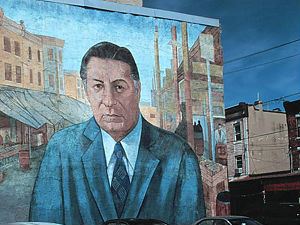
Since Philadelphia's Mural Arts Program began in the 1980s, they managed to transform hundreds of graffiti tagged walls and buildings into legitimate and authorized works of art.

For the most part it's been successful, and has been widely repeated in cities across the country. Graffiti artists typically avoid sites that have been transformed into murals and opt to create their own murals on vacant properties with absentee landlords, or other sites not necessarily conducive to traditional wall art.


But the Mural Arts Program's model has shifted it's goal. Instead of solely addressing blight, the MAP employs artists with a presence. Intended to temporarily camouflage vacant lots, some of their own murals have actually inhibited future development that threatens their murals. With more MAP murals visible in prominent neighborhoods not tagged with graffiti than the blighted ones that could use a splash of color, graffiti artists have become the city's unofficial, interim mural program painting communities that struggle.

When you consider this, the MAP's success becomes debatable. Local architecture and art critics have gone as far as criticizing the program, not just its forgotten purpose, but even the quality of some of its works. Obviously criticizing any organization rooted in charity and good intentions draws its own criticism.

Whatever the case, MAP's goal of eradicating graffiti and blight hasn't been met. Perhaps it shouldn't.

New programs throughout the country have been set up to address graffiti in a more dynamic way. San Diego's Writerz Blok encourages curious wall artists to fine tune their talent by designating public space in their own urban studio.

Instead of covering up graffiti with paintings of Frank Sinatra and Ed Bacon, the Writerz Blok works with the city's street art community, offers them space to work, teaches them technique, and perhaps most importantly, what's appropriate and where.

It's not always good.

The unfortunate reality proven by aerosol and history is that graffiti will always find a presence as vandalism. But we've also learned that the MAP, for all its good intentions, has run its course as the sole solution to a problem. Perhaps that's aided by a lack of competition.

By putting one and only one program in charge of attacking blight through art, some of it has become trite and some unnecessary. Someone recently even suggested painting a mural on the south side of the historic PSFS Building, a blank tile wall that architects William Lescaze and George Howe described as their favorite.

It isn't always bad.
(Flickr user LoisInWonderland)

Obviously, a graffiti park is simply a place to teach and does little outside the workspace itself. One could even argue that it encourages vandalism. But with the right structure and guidance it doesn't have to.

In fact, programs like the Writerz Blok could be taken beyond the scope of their own designated walls and into the city through authorized programs, perhaps even working with the Mural Arts Program to add a new perspective to MAP's signature style.