A couple friends and I recently found our way to an abandoned coal pier near Port Richmond. We likely weren't supposed to be there, along with a few others fishing and swimming in the Delaware (which is probably less advised than actually walking on the relic). But what we also found were about a dozen graffiti artists adorning the towering concrete and twisted rebar with layers upon layers of ever changing artwork.
Call graffiti what you will: art or vandalism. With graffiti's unique style finding its way into major galleries, the line is fine and only technical. Someone could tag City Hall with a Renaissance masterpiece, and the only thing that distinguishes it between art and vandalism is a permit to paint.
The bottom line is that some of the stuff thrown up on vacant buildings in the middle of the night is not only better than most of the modern wing at the PMA, but also talented in the feat of accomplishing such works so quickly and unseen.
Likely much of what was taking place on this rusted pier was practice. Graffiti artists want to be recognized and they want their work to be seen in mind bending locations that make their audience scratch their heads from the Schuylkill Express way and think, "well how the heck did they get up there?"
Still, in and of itself, graffiti is gradually becoming a legitimate and respected genre in the art community, particularly when displayed privately and without the legal implications of trespassing.
Whether a graffiti artist is particularly talented doesn't always make the work appropriate. Again, tagging City Hall with a masterpiece might display talent, but even if it were to be authorized it would be unsightly and unnecessary.
While many street artists respect their surroundings and have taken to gracing otherwise useless and abandoned eyesores - a rogue Mural Arts Program - just as many callously scar historic landmarks, private homes, and even the natural spaces that abound Philadelphia like Fairmount Park.
It's hard to find your inner peace along Forbidden Drive or Wissahickon Valley when a crudely drawn tag reminds you exactly where you are.
Graffiti isn't new, it isn't an epidemic, and cities have been trying to address it as a problem since spray paint was invented. In fact ancient graffiti has been found around the world, even on cave paintings predating any semblance of modern civilization.
Since Philadelphia's Mural Arts Program began in the 1980s, they managed to transform hundreds of graffiti tagged walls and buildings into legitimate and authorized works of art.
For the most part it's been successful, and has been widely repeated in cities across the country. Graffiti artists typically avoid sites that have been transformed into murals and opt to create their own murals on vacant properties with absentee landlords, or other sites not necessarily conducive to traditional wall art.
But the Mural Arts Program's model has shifted it's goal. Instead of solely addressing blight, the MAP employs artists with a presence. Intended to temporarily camouflage vacant lots, some of their own murals have actually inhibited future development that threatens their murals. With more MAP murals visible in prominent neighborhoods not tagged with graffiti than the blighted ones that could use a splash of color, graffiti artists have become the city's unofficial, interim mural program painting communities that struggle.
When you consider this, the MAP's success becomes debatable. Local architecture and art critics have gone as far as criticizing the program, not just its forgotten purpose, but even the quality of some of its works. Obviously criticizing any organization rooted in charity and good intentions draws its own criticism.
Whatever the case, MAP's goal of eradicating graffiti and blight hasn't been met. Perhaps it shouldn't.
New programs throughout the country have been set up to address graffiti in a more dynamic way. San Diego's Writerz Blok encourages curious wall artists to fine tune their talent by designating public space in their own urban studio.
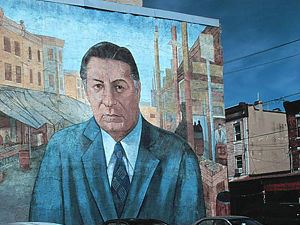
Instead of covering up graffiti with paintings of Frank Sinatra and Ed Bacon, the Writerz Blok works with the city's street art community, offers them space to work, teaches them technique, and perhaps most importantly, what's appropriate and where.
 |
| It's not always good. |
The unfortunate reality proven by aerosol and history is that graffiti will always find a presence as vandalism. But we've also learned that the MAP, for all its good intentions, has run its course as the sole solution to a problem. Perhaps that's aided by a lack of competition.
By putting one and only one program in charge of attacking blight through art, some of it has become trite and some unnecessary. Someone recently even suggested painting a mural on the south side of the historic PSFS Building, a blank tile wall that architects William Lescaze and George Howe described as their favorite.
 |
It isn't always bad.
(Flickr user LoisInWonderland) |
Obviously, a graffiti park is simply a place to teach and does little outside the workspace itself. One could even argue that it encourages vandalism. But with the right structure and guidance it doesn't have to.
In fact, programs like the Writerz Blok could be taken beyond the scope of their own designated walls and into the city through authorized programs, perhaps even working with the Mural Arts Program to add a new perspective to MAP's signature style.