Showing posts with label graffiti. Show all posts

Friday, June 20, 2014

Kid Hazo Impressed Visit Philly, and we all felt the LOVE

I've made this unsubstantiated claim before: Philadelphia has more public art than any city in the world. By that I'm referring to professionally commissioned works of art. Some might be quick to argue, but it's easier to understand how much public art we hold when you consider that the Mural Arts Program alone has commissioned more than 3000 public paintings.

When you go beyond the realm of the "professional" installations and into the world of rogue street artists, Philadelphia is in a league of its own. 

Street art obviously isn't unique to Philadelphia. It's fostered to battle graffiti in San Diego. Banksy's left his stamp (literally) on cities around the globe. What's unique to Philadelphia is how the city turns a blind eye to most of our street art, and in return, our street art has transformed from angry messages hastily scrawled across public buildings to quality works or art that take time an effort. 

Dozens of mysterious Toynbee Tiles can still be found throughout the city and only vanish when a street needs to be repaired. Chicago on the other hand has declared them "vandalism," and when they are found, they are removed. Although some might not consider the tiles "art," but rather a message from a local madman, they're representative of Philadelphia's love for all art.

The city's embrace of the best and most unique rogue works of art has created an off-the-grid art community that competes much like the world of traditional artists, constantly changing, evolving, and reinventing themselves to stay at the top of their game.

Kid Hazo has become one of Philadelphia's favorite street artists. His installations parody the city's beleaguered services and tired campaigns in a way that tows the fine line between kitsch and obnoxious political statements. Quite simply, he's managed to accomplish the rare feat of being fun and smart.

Recently, Kid Hazo took on Visit Philly's "With Love" campaign with posters stating things like "Dear Liberty Bell, Crack Kills! Just Sayin." But Visit Philly didn't respond with a curmudgeonly press release denouncing his art as vandalism, they Tweeted their very own Thank You poster.

With Love, Indeed.


Wednesday, October 30, 2013

Banksy's Irrelevant Opinion

Often the line between editorials and rants is fine and technical. Editorials are opinionated, but backed by personal points of reference and alternatives. They are intended to foster debate, not blow off steam.

Rants typically consist of "grass is greener" jargon and argument bait. Of course rants are usually published in the comments below an article so by the time an argument ensues, the writer is long gone.

Banksy, London's popular yet illusive graffiti artist, has been making his way through New York City.

Some love him and some hate him. Some think he's a vandal, others a political statement. Few claim to know who he is.

But this isn't about Banksy the artist. It's about Banksy the self professed architecture critic.

Banksy's mock New York Times page, including the article he presented as an editorial.

Banksy recently presented an editorial to the New York Times, a rant attempting to eviscerate the design for the city's new One World Trade Center. His editorial is full of 9-11 bait claiming the "shyscraper" proves the terrorists won simply because he doesn't care for the building.

His commentary is too literal to delve into. The true problem with his article is it serves no purpose. Not liking the new WTC is fine. It's been both torn apart and praised by architecture critics around the world. Any opinion can be validated.

But Banksy fails to mention why. He offers no alternatives, perhaps because he isn't versed in architecture enough to know where to go. Instead of citing similar designs, better designs, or even comparing it to the original World Trade Center, he suggests "kids with roller poles" tag the façade.

Returning the commentary Banksy started back to his comfort zone is elementary. But he's not even doing that. His writing is trite. If he thinks the WTC would look better tagged with his Blek le Rat rip offs, tell us why.

But he can't. One of the biggest differences between an editorial and a rant, especially when published online, is the anonymity of the author. In order to have a legitimate opinion you have to be available to answer to it.

It's not surprising that the New York Times declined to publish his editorial. The mysterious nature that surrounds his identity excuses himself from any debate. It allows him to scream and the sun with no accountability. 

Banksy took the Times' snub to the streets, tagging an unrelated Brookly building with the words, "This site contains blocked messages," as if the Times was censoring his words. It does his artwork no service, particularly when One World Trade Center has been no stranger to criticism.

Banksy's reaction to the New York Times' snub suggesting that the Times censored his work. Confusing censorship with bad writing, Banksy fails to note that every news outlet in the nation published a copy of his editorial in one way or another.
The juvenile words in his unpublished (now published everywhere) New York Times editorial expose flaws in the man's creativity and talent.

Much - perhaps all - of Banksy's success stems from his mystique.

A lot of artists prefer anonymity. But it's one thing to want to exercise your craft and be left alone. It's another to get off on being noticed, on stirring up shit, and then vanish before anyone can ask for a follow up.

The cultural statement in Banksy's art has always been subversive, and graffiti has been the perfect medium for his message. But his editorial opens up the motivation as a political rabblerouser.

Did he not get the reception in New York that he expected? Was he annoyed that One World Trade Center overshadowed the grace of his presence. We'll never know. His position is almost voyeuristic.

Banksy's success in art circles hinged on his absence. The interesting thing about being an anonymous artist is that the second you succeed, you're no longer successful. If the one quality that sets you apart from other outsider artists is that no one knows who you are, then the mysterious allure that gives your work any credibility is gone the moment you submit an article to the New York Times.

Whether the identity of Banksy has been exposed or not, we now know enough about the man to examine his work at face value. Compared to the extravagant graffiti that adorns the lesser parts of New York City and much of Philadelphia, without mystery Banksy's stencils are boring and his installations look like marketing gimmicks, an anti-establishment Target advertisement.

London and New York City have separate cultural issues. Perhaps Banksy doesn't get that. Maybe he doesn't understand the difference between censorship and bad writing. If Banksy wanted to test the international waters, he should have remained humble, because right now he looks like an ass.

Saturday, September 7, 2013

Graffiti Parks and the Mural Arts Program

A couple friends and I recently found our way to an abandoned coal pier near Port Richmond. We likely weren't supposed to be there, along with a few others fishing and swimming in the Delaware (which is probably less advised than actually walking on the relic). But what we also found were about a dozen graffiti artists adorning the towering concrete and twisted rebar with layers upon layers of ever changing artwork.


Call graffiti what you will: art or vandalism. With graffiti's unique style finding its way into major galleries, the line is fine and only technical. Someone could tag City Hall with a Renaissance masterpiece, and the only thing that distinguishes it between art and vandalism is a permit to paint.

The bottom line is that some of the stuff thrown up on vacant buildings in the middle of the night is not only better than most of the modern wing at the PMA, but also talented in the feat of accomplishing such works so quickly and unseen.

Likely much of what was taking place on this rusted pier was practice. Graffiti artists want to be recognized and they want their work to be seen in mind bending locations that make their audience scratch their heads from the Schuylkill Express way and think, "well how the heck did they get up there?"

Still, in and of itself, graffiti is gradually becoming a legitimate and respected genre in the art community, particularly when displayed privately and without the legal implications of trespassing.

Whether a graffiti artist is particularly talented doesn't always make the work appropriate. Again, tagging City Hall with a masterpiece might display talent, but even if it were to be authorized it would be unsightly and unnecessary.

While many street artists respect their surroundings and have taken to gracing otherwise useless and abandoned eyesores - a rogue Mural Arts Program - just as many callously scar historic landmarks, private homes, and even the natural spaces that abound Philadelphia like Fairmount Park.

It's hard to find your inner peace along Forbidden Drive or Wissahickon Valley when a crudely drawn tag reminds you exactly where you are.


Graffiti isn't new, it isn't an epidemic, and cities have been trying to address it as a problem since spray paint was invented. In fact ancient graffiti has been found around the world, even on cave paintings predating any semblance of modern civilization.


Since Philadelphia's Mural Arts Program began in the 1980s, they managed to transform hundreds of graffiti tagged walls and buildings into legitimate and authorized works of art.

For the most part it's been successful, and has been widely repeated in cities across the country. Graffiti artists typically avoid sites that have been transformed into murals and opt to create their own murals on vacant properties with absentee landlords, or other sites not necessarily conducive to traditional wall art.


But the Mural Arts Program's model has shifted it's goal. Instead of solely addressing blight, the MAP employs artists with a presence. Intended to temporarily camouflage vacant lots, some of their own murals have actually inhibited future development that threatens their murals. With more MAP murals visible in prominent neighborhoods not tagged with graffiti than the blighted ones that could use a splash of color, graffiti artists have become the city's unofficial, interim mural program painting communities that struggle.

When you consider this, the MAP's success becomes debatable. Local architecture and art critics have gone as far as criticizing the program, not just its forgotten purpose, but even the quality of some of its works. Obviously criticizing any organization rooted in charity and good intentions draws its own criticism.

Whatever the case, MAP's goal of eradicating graffiti and blight hasn't been met. Perhaps it shouldn't.

New programs throughout the country have been set up to address graffiti in a more dynamic way. San Diego's Writerz Blok encourages curious wall artists to fine tune their talent by designating public space in their own urban studio.

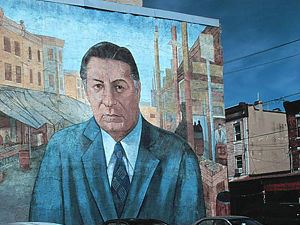
Instead of covering up graffiti with paintings of Frank Sinatra and Ed Bacon, the Writerz Blok works with the city's street art community, offers them space to work, teaches them technique, and perhaps most importantly, what's appropriate and where.

It's not always good.

The unfortunate reality proven by aerosol and history is that graffiti will always find a presence as vandalism. But we've also learned that the MAP, for all its good intentions, has run its course as the sole solution to a problem. Perhaps that's aided by a lack of competition.

By putting one and only one program in charge of attacking blight through art, some of it has become trite and some unnecessary. Someone recently even suggested painting a mural on the south side of the historic PSFS Building, a blank tile wall that architects William Lescaze and George Howe described as their favorite.

It isn't always bad.
(Flickr user LoisInWonderland)

Obviously, a graffiti park is simply a place to teach and does little outside the workspace itself. One could even argue that it encourages vandalism. But with the right structure and guidance it doesn't have to.

In fact, programs like the Writerz Blok could be taken beyond the scope of their own designated walls and into the city through authorized programs, perhaps even working with the Mural Arts Program to add a new perspective to MAP's signature style.