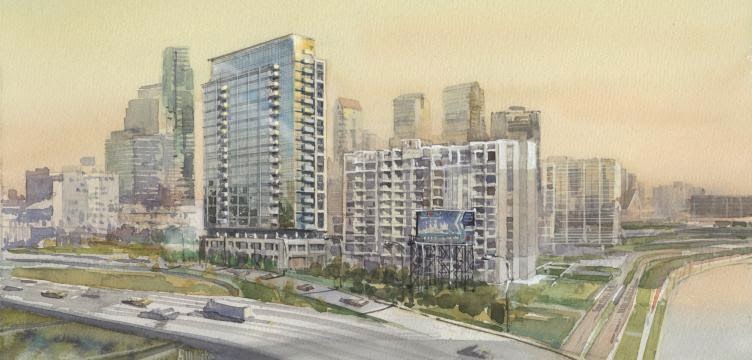
If you aren't high enough on all the skyscraping (heh, get it?) proposals and construction taking place throughout the city, Parkway Corporation has proposed a 32 story apartment building to replace a surface parking lot at 709 Chestnut Street near Washington Square.
Parkway needs approval from three organizations: the Washington Square West Civic Association, the Historical Commission, and the Civic Design Review Committee.
At 45 stories, The Saint James is the tallest building in the vicinity. Although its situation on Washington Square would seem to have set a precedent for the neighborhood, its construction called for the near-complete demolition of a row of handsome Colonial townhouses that left preservationists none too happy.
While replacing a surface lot with...anything...seems like a no-brainer, neighbors are likely suspicious of any residential development that comes with such height.
Monday, March 30, 2015
PHS's Memorial Plaza
With Dilworth Plaza converted into a green Dilworth Park and the Schuylkill Banks Boardwalk gliding atop the river, it's hard to look at the Philadelphia Horticultural Society's plans for the approach to the Ben Franklin Bridge and think, "bold."
The renderings are undoubtedly beautiful, and ever since Franklin Square was renovated, the base of the bridge has been an eyesore flanking Old City and Independence Mall.
Like Dilworth Plaza, Monument Plaza at 6th and Race is a slab of uninspired concrete with some questionable artwork. Isamu Noguchi's A Bolt of Lightning...A Memorial to Benjamin Franklin is pretty cool looking, until you see the kite and key and realize just how literal the work of art is.
But unlike Dilworth Plaza, which was usable even before its renovation, Memorial Plaza is almost entirely inaccessible. Unless you want to dart across five lanes of Jersey bound traffic, you're not getting there.
And that is what truly makes the PHS's plan bold. It dares not only to remove a lane from 6th Street and two bridge entrance ramps, it dares to take away asphalt from those heading to New Jersey.
There's no love lost between Pennsylvania and New Jersey. Before eastbound commuters make it through Chinatown they're pissed off and ready to get home, and most are high as Ben Franklin's kite on road rage.
The new configuration would be great for Philadelphia. It will discourage commuters from leaving the city via Race, diverting them to Vine and 676, alleviating rush hour traffic through Chinatown by forcing it to the wider streets and expressway created specifically for commuters. But that is exactly what will ruffle feathers with many heading to New Jersey.
Unfortunately, trading streets for parks has never set well with those in charge of the approval process. It's nearly impossible to convince urban decision makers to look ahead.
This plan has all the makings of the ultimate suburban turf warfare. Commuters will fear traffic jams, Negadelphians will look at a nonexistent park with a perceived nonexistent future, and NIMBYs will bitch about it all because that's what they do.
But for the city, Memorial Plaza is the last piece of Independence Mall's seventy year journey. It links Franklin Square to the Constitution Center with beautiful views of the Ben Franklin Bridge, and continuous green space that extends to Society Hill and ultimately the Delaware River. In short, it makes sense. But logic often takes a backseat to ire when it's fueled by road rage.
The renderings are undoubtedly beautiful, and ever since Franklin Square was renovated, the base of the bridge has been an eyesore flanking Old City and Independence Mall.
Like Dilworth Plaza, Monument Plaza at 6th and Race is a slab of uninspired concrete with some questionable artwork. Isamu Noguchi's A Bolt of Lightning...A Memorial to Benjamin Franklin is pretty cool looking, until you see the kite and key and realize just how literal the work of art is.
But unlike Dilworth Plaza, which was usable even before its renovation, Memorial Plaza is almost entirely inaccessible. Unless you want to dart across five lanes of Jersey bound traffic, you're not getting there.
And that is what truly makes the PHS's plan bold. It dares not only to remove a lane from 6th Street and two bridge entrance ramps, it dares to take away asphalt from those heading to New Jersey.
There's no love lost between Pennsylvania and New Jersey. Before eastbound commuters make it through Chinatown they're pissed off and ready to get home, and most are high as Ben Franklin's kite on road rage.
The new configuration would be great for Philadelphia. It will discourage commuters from leaving the city via Race, diverting them to Vine and 676, alleviating rush hour traffic through Chinatown by forcing it to the wider streets and expressway created specifically for commuters. But that is exactly what will ruffle feathers with many heading to New Jersey.
Unfortunately, trading streets for parks has never set well with those in charge of the approval process. It's nearly impossible to convince urban decision makers to look ahead.
This plan has all the makings of the ultimate suburban turf warfare. Commuters will fear traffic jams, Negadelphians will look at a nonexistent park with a perceived nonexistent future, and NIMBYs will bitch about it all because that's what they do.
But for the city, Memorial Plaza is the last piece of Independence Mall's seventy year journey. It links Franklin Square to the Constitution Center with beautiful views of the Ben Franklin Bridge, and continuous green space that extends to Society Hill and ultimately the Delaware River. In short, it makes sense. But logic often takes a backseat to ire when it's fueled by road rage.
Sunday, March 29, 2015
3201 Race
University City isn't done challenging Center City. Radnor Property Group has proposed a new 200 foot apartment building at 32nd and Race and it's pretty sexy. If it happens, this 17 story Erdy-McHenry bad ass will be situated along 30th Street Station's Amtrak lines and beefing up University City's growing skyline.
Monday, March 23, 2015
Avenue of the Wawa
Philadelphia may be on the fast track to becoming the nation's third tallest city, Market East is on the brink of an unthinkable renaissance, but there's one thing that seems to capture the attention of natives and transplants more than tall buildings, City Council elections, and potholes: and that's a made-to-order hoagie.
More specifically, a hoagie from Wawa.
Wawa announced it will be opening a new location at Broad and Walnut, a key corner on the Avenue of the Arts formerly occupied by Robinson's Luggage, and today our corner of the internet went wild.
The location seemed primed for an upscale restaurant, but the reality in most pedestrian oriented cities calls for high volume on heavily trafficked corners, not high end. And the Avenue of the Arts probably does deserve an all night convenience store, so why not make it a local one?
More specifically, a hoagie from Wawa.
Wawa announced it will be opening a new location at Broad and Walnut, a key corner on the Avenue of the Arts formerly occupied by Robinson's Luggage, and today our corner of the internet went wild.
The location seemed primed for an upscale restaurant, but the reality in most pedestrian oriented cities calls for high volume on heavily trafficked corners, not high end. And the Avenue of the Arts probably does deserve an all night convenience store, so why not make it a local one?
Sunday, March 22, 2015
The Rundown
Some of it's happening, some of it is possible, and some of it may be stale. It's the construction, the approvals the proposals, and the weird. Here's your official rundown of skyline altering development taking place in and around Center City:
Comcast
Liberty Property Trust
Foster + Partners
Cira Centre South (FMC Tower)
FMC Corporation
Brandywine Realty Trust
Pelli Clarke Pelli
SLS International Hotel and Residences
SLS International
Dranoff Properties
Philippe Starck
LoSo Entertainment Center
Attraction
PHL Local Gaming
U.S. Thrill Rides
W Hotel and Residences
Hotel
Starwood Hotels
Cope Linder
1911 Walnut
![]() |
| Previous proposal |
525 feet (previously)
200 feet (previously)
Hotel and Condominium (previously)
Southern Land Company
KingStubbins (previously)
Market8
Casino
Goldenberg Group, Mohegan Tribal Gaming Authority
TBA
Riverwalk
220 feet
220 feet
Apartments
NP International
Gensler Associates
MIC Tower
Apartments
Brickstone Realty
Stantec Architecture
500 Walnut
Condominiums
Scannapieco Development Corporation
Cecil Baker + Partners Architects
CHoP Schuylkill Avenue Project
Hospital
Children's Hospital of Philadelphia
Cooper, Robertson, & Partners
1601 Vine Street
Apartments
Church of Jesus Christ of Latter Day Saints
Robert A. M. Stern Architects
1919 Market
Apartments
Brandywine Realty Trust
BartonPartners
3601 Market
Apartments
University City Science Center, Wexford Equities, Southern Land Company
BLT Architects
SugarHouse Casino Phase 3
Casino
SugarHouse Casino
Cope Linder
Skyview Tower
Attraction
Adventure Aquarium
Herschend Family Entertainment
1213 Walnut
Apartments
U3 Ventures
Ten Arquitectos
1900 Chestnut
Apartments
Pearl Properties
DAS Architects
Renaissance Plaza
292 feet
195 feet
195 feet
Mixed Use
Waterfront Renaissance Associates
Alesker & Dundon
CHoP Ambulatory Center
Hospital
Children's Hospital of Philadelphia
Pelli Clarke Pelli
The Summit
Student Housing
Drexel University
Solomon Cordwell Buenz Architects
3737 Chestnut
Apartments
Radnor Property Group
BLT Architects
Edgewater II
Mixed Use
Realen Properties
TBA
Eastern Tower
Community Center and Apartments
Philadelphia Chinatown Development Corporation
KlingStubbins
One Riverside
Apartments
Dranoff Properties
Cecil Baker + Partners Architects
One Water Street
Apartments
PMC Property Group
Varenhorst
205 Race
Apartments
Brown Hill Development
Peter Gluck & Partners
Museum Towers II
Apartments
Forest City Residential
Perkins Eastman
Broad & Washington
Mixed Use
Tower Investments, Inc.
TBA
The Residences at Schmidt's
15 floors
Apartments
Tower Investments
TBA
2400 Market
Mixed Use
PMC Property Group
TBA
East Market
Mixed Use
National Real Estate Advisors, Young Capital, Joss Realty, SSH Real Estate
BLT Architects
1528 Cherry
Apartments
Ambit Architecture
Ambit Architecture
Baywood Hotel
Hotel
Kurt Blorstad
Brett Webber and Richard Gelber
Waterfront Square
TBA
Condominiums
Grasso Holdings
Wallace Roberts & Todd
Friday, March 20, 2015
Keeping Public Art Public
Philadelphians may live amongst more public art than any city in the world. Before you stop me, consider the more than 3,600 murals commissioned by the Mural Arts Program. Not to mention the seemingly endless supply of carved and cast historical figures, some tucked inconspicuously deep into the woods of Fairmount Park, as well as the modern works incorporated into nearly every commercial and residential development project.
Our city is our greatest museum. And it shows. Because of our vast portfolio of public art, Philadelphia is home to hundreds of amateur and professional photographers, bloggers, and independent periodicals that drape Philadelphia's corner of the internet with the works that have made urban art synonymous with our city.
Elsewhere, the Statue of Liberty is one of the most photographed works of art in the world. It's been recreated in plastic, screen printed onto t-shirts, and brought to life in Ghostbusters II. Closer to modernity, Robert Indiana's LOVE statue which has been placed around the word in multiple languages, is photographed, printed, and sold without any hassle.
But some places aren't so lucky. Few may know that the country's second largest copper statue sits above the entrance to a municipal building in the Pacific Northwest. In fact, facing a tree filled park, it's kind of hard to see. More people may know about Portland's beautiful Portlandia if artist Raymond Kaskey hadn't spent the last three decades threatening to sue anyone who attempts to use an image of his work.
When Portlandia arrived in Portland, the city's Metropolitan Arts Commission decided to allow artists to intellectually retain ownership of their public works of art.
Kaskey has been quoted as saying, "Not many cities respected artists' rights in those days." They weren't? Was $328,000 disrespectful...in 1985? It's not as if he commissioned the work himself. I don't want to delve too deeply into the notion of what constitutes art, but if Norman Foster is commissioned for a skyscraper, can he sue everyone who profits from a photograph of the city skyline for copyright infringement?
There's obviously some sort of empirical delineation between buildings and art in Portland, or at least I hope there is. But if cities like New York, Chicago, or Philadelphia were burdened with such rigid regulations, it would be impossible for a photographer to make a living photographing the people and places within our cities.
Portland is no stranger to its nanny's overreaching arm, but this particular regulation is capitalistically counter to the city's largely liberal ideals. They aren't protecting the rights of their artists, they're allowing Kaskey to essentially collect residuals from lawsuits long after he skipped town. Meanwhile their urban photographers have to tiptoe around the city for fear of inadvertently photographing intellectual property.
Luckily most public artists understand their public position, they even embrace it. Photography and replication isn't just flattery, it's free publicity. Unfortunately Kaskey's talent is trumped by his greed, and an otherwise beautiful statue is tainted by what it represents.
Our city is our greatest museum. And it shows. Because of our vast portfolio of public art, Philadelphia is home to hundreds of amateur and professional photographers, bloggers, and independent periodicals that drape Philadelphia's corner of the internet with the works that have made urban art synonymous with our city.
Elsewhere, the Statue of Liberty is one of the most photographed works of art in the world. It's been recreated in plastic, screen printed onto t-shirts, and brought to life in Ghostbusters II. Closer to modernity, Robert Indiana's LOVE statue which has been placed around the word in multiple languages, is photographed, printed, and sold without any hassle.
![]() |
| IMAGE: wweek.com |
But some places aren't so lucky. Few may know that the country's second largest copper statue sits above the entrance to a municipal building in the Pacific Northwest. In fact, facing a tree filled park, it's kind of hard to see. More people may know about Portland's beautiful Portlandia if artist Raymond Kaskey hadn't spent the last three decades threatening to sue anyone who attempts to use an image of his work.
When Portlandia arrived in Portland, the city's Metropolitan Arts Commission decided to allow artists to intellectually retain ownership of their public works of art.
Kaskey has been quoted as saying, "Not many cities respected artists' rights in those days." They weren't? Was $328,000 disrespectful...in 1985? It's not as if he commissioned the work himself. I don't want to delve too deeply into the notion of what constitutes art, but if Norman Foster is commissioned for a skyscraper, can he sue everyone who profits from a photograph of the city skyline for copyright infringement?
There's obviously some sort of empirical delineation between buildings and art in Portland, or at least I hope there is. But if cities like New York, Chicago, or Philadelphia were burdened with such rigid regulations, it would be impossible for a photographer to make a living photographing the people and places within our cities.
Portland is no stranger to its nanny's overreaching arm, but this particular regulation is capitalistically counter to the city's largely liberal ideals. They aren't protecting the rights of their artists, they're allowing Kaskey to essentially collect residuals from lawsuits long after he skipped town. Meanwhile their urban photographers have to tiptoe around the city for fear of inadvertently photographing intellectual property.
Luckily most public artists understand their public position, they even embrace it. Photography and replication isn't just flattery, it's free publicity. Unfortunately Kaskey's talent is trumped by his greed, and an otherwise beautiful statue is tainted by what it represents.
The Urban Arcade
Shopping malls might be as American as suburbia, but like apple pie and pizza, we didn't technically invent either. Gostiny Dvor in St. Petersburg, FL is commonly accepted as the first shopping mall, but that and other early examples are often a combination of indoor bazars and European arcades. In that regard, the foundation for shopping malls is rooted in Ancient Rome, perhaps even earlier.
History aside, the American shopping mall as we know it is unquestionably dying. Hanging out at the mall was a great pastime for teenagers in the 80s and 90s, but actually shopping at a mall was born from a need. Before online shopping, malls were a one stop approach to a retail experience now easily accessed on our iPads. Suburban malls have no choice but to continue catering to a market that is fading because, architecturally, there's little else you can do with the space.
But in the digital age, these once convenient solutions have become burdensome. They are destinations, and often troublesome to reach. Traffic jams, jug handles, parking, and lines can be circumvented with the click of a button on amazon.com.
Urban malls, on the other hand, have always been a bit unique. They were designed to serve the same needs as those in King of Prussia or Cherry Hill, as well as to keep downtown shoppers from fleeing to the 'burbs for Sears. But as suburban malls continue to stagnate and struggle to evolve, these urban shopping malls that have outlived what little usefulness they once provided are reinventing the urban shopping experience by looking to history.
Ironically, urban malls like Eaton Centre in Toronto and Pioneer Place in Portland, are experiencing a resurgence while their suburban counterparts continue to fail. While suburban malls must rely on their place as isolated attractions, urban malls can grab foot traffic and tourists, and like the Gallery at Market East or Pentagon City Mall in Arlington, VA, are frequently integrated with public transportation. But urban malls can succeed by the mere fact that they're downtown. They have a logistical advantage if their management chooses to embrace it.
Food courts allow coworkers and families to grab lunch at their favorite spots while also allowing them to dine in the same place. It doesn't take a lot to make these places work, just proper management and an understanding that their target audience is unique to the inner city crowd and often supplemental, not direct.
Ignore the suburban counterparts and begin looking at urban malls as modern European arcades. The Gallery is far from the best example, but it has far more potential than a dying suburban mall.
History aside, the American shopping mall as we know it is unquestionably dying. Hanging out at the mall was a great pastime for teenagers in the 80s and 90s, but actually shopping at a mall was born from a need. Before online shopping, malls were a one stop approach to a retail experience now easily accessed on our iPads. Suburban malls have no choice but to continue catering to a market that is fading because, architecturally, there's little else you can do with the space.
But in the digital age, these once convenient solutions have become burdensome. They are destinations, and often troublesome to reach. Traffic jams, jug handles, parking, and lines can be circumvented with the click of a button on amazon.com.
Urban malls, on the other hand, have always been a bit unique. They were designed to serve the same needs as those in King of Prussia or Cherry Hill, as well as to keep downtown shoppers from fleeing to the 'burbs for Sears. But as suburban malls continue to stagnate and struggle to evolve, these urban shopping malls that have outlived what little usefulness they once provided are reinventing the urban shopping experience by looking to history.
![]() |
| What our urban malls could be. |
Ironically, urban malls like Eaton Centre in Toronto and Pioneer Place in Portland, are experiencing a resurgence while their suburban counterparts continue to fail. While suburban malls must rely on their place as isolated attractions, urban malls can grab foot traffic and tourists, and like the Gallery at Market East or Pentagon City Mall in Arlington, VA, are frequently integrated with public transportation. But urban malls can succeed by the mere fact that they're downtown. They have a logistical advantage if their management chooses to embrace it.
Food courts allow coworkers and families to grab lunch at their favorite spots while also allowing them to dine in the same place. It doesn't take a lot to make these places work, just proper management and an understanding that their target audience is unique to the inner city crowd and often supplemental, not direct.
Ignore the suburban counterparts and begin looking at urban malls as modern European arcades. The Gallery is far from the best example, but it has far more potential than a dying suburban mall.
Subscribe to:
Posts (Atom)