Sunday, February 17, 2013

Casino Craze: Part Deux

Bart Blatstein resurrected the Great Casino Debate with his proposed entertainment complex at the Inquirer Building which, admittedly, I think is a bit too Vegas for Center City. Not the casino itself, mind you, but the Tiny Town he proposed building on the roof of the building.

With a little excitement behind the second leg of the debate (and a lot of resistance), developer Ken Goldenberg has thrown his name into the casino hat with a proposal at a much more logical location: Market East. More specifically, the abhorred Disney Hole. Of course it's easy to dub this proposal Disney 2.0, but the same could be said for any entertainment project of this scale.


The preliminary rendering is vague at best, but pretty sleek. Backed by Campus Apartments and Deutsch Bank, the promise of investors are just as exciting as a destination attraction on our forlorn Market East.

Called Market8, Goldberg is off to a good start claiming the entertainment complex will only "happen to have a casino." The venue would offer numerous restaurants and retail, and best of all, underground parking.

Bye-bye, Disney Hole.

Hey, I'm a dreamer.

The multi-faceted approach isn't just the best way to pitch a casino, but the city should have required the approach all along.

SugarHouse was one of the city's biggest planning debacles. The proposal was grand, but phased, and the first phase called for a slot barn and a parking garage.

It's funny how the city decides to exert its muscle. They micromanage parks and condos, but when it came to SugarHouse, there were no caveats.


For the record, I'm all for casinos. Not personally. They're trashy, tacky, and for me, a waste of money. However, the same could be said for City Council itself.

But Philadelphia is big enough to provide plenty of entertainment for everyone. A lot of people sell the city short, not the least of which are those who rabidly charge themselves with saving Market East. Those activists have cost the city millions debating benign improvements to this part of town.

Philadelphia is chock full of quaint Colonialism, but we aren't Williamsburg and Market East isn't the place to preserve history, particularly when its few historic properties are already protected. Give the Capitalists their playground.

With that said, the State and City missed the mark with SugarHouse, and we have a second chance to work hand in hand with private developers to mark drastic improvements to our city's core.


I will never understand why the city didn't grant SugarHouse a casino license only contingent on better development. SugarHouse's proposal had plenty of competition. They would have done anything to get that license. The city missed an opportunity to get a lot of free improvements. City Council could have gotten more than just the dynamic casino complex SugarHouse originally proposed, we could have gotten a free Delaware Avenue lightrail.

At this point SugarHouse can likely claim that it's not profitable to expand it's non-gaming oriented entertainment or hotel. I doubt that's true, but the city put no requirements on them to expand, so they're content. If the city required a hotel and convention space as part of SugarHouse's "Phase 1" the project would be a lot more exciting than it is.


If Market8 has a chance at becoming a reality, the city should seize the opportunity to not just require more than a casino from Goldenberg's venue, but ask him to flip the bill for some of the improvements this corridor desperately needs.

Thursday, February 14, 2013

It Could Be Worse: Washington's Windowless Apartments

Philadelphia has it's problems, but when it comes to the supply and demand for housing, a healthy balance leads developers to offer the public some exciting architecture. In other words, people want to live here, but they won't just buy or rent something simply because it exists.

My former home, the city that rents $3000 a month "English Basements," has lowered the bar once again, not only allowing the development of windowless lofts, but touting them as trendy, and even affordable.

Adaptive reuse is a wonderful thing. It saves resources and history. But there is no history or significance left at what is now a Harris Teeter grocery store in Washington D.C.'s Adams Morgan neighborhood.


Transforming this attic roller rink into lofts is Douglas Development's cheap and thoughtless attempt to maximize space. What's worse, it sets a precedent for irresponsible residential development in a city that houses a bottomless pit of uninspired and overpriced apartments.


There are no legal accounts of windowless apartments in the developed world. None. There are cheap hotels, hostels, and slum lords renting unregulated rooms without windows, but there is not one record of a legitimate developer providing a new, windowless unit as a legitimate apartment. Not one.


If your Google skills are better than mine, please feel free to let me know. I can't find one.


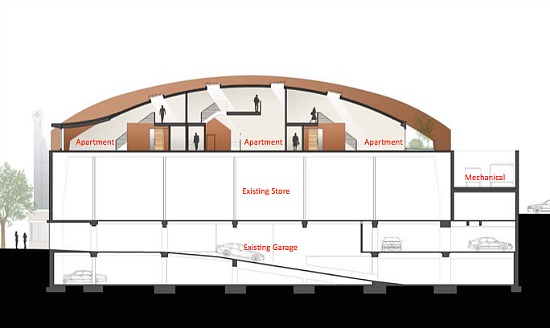
The Citadel Apartments will provide 31 apartment units, with 8 occupying the center of the domed space. Of course it doesn't take an architect - or a genius - to suggest a better use for this space.

A respectful developer would open the roof to provide outdoor space for the 23 windowed units. The size of the 23 outer units could be expanded, placing the kitchens and living rooms in the center so that windows could light the bedrooms. Even if the developer wanted to reasonably maximize the space, lowering the roof and ceiling of the outer ring could allow for elevated windows in the center apartments.

Instead, architects at R2L provide sun to the center units by way of skylights 20 feet above. Most architects would call this a chimney. L&I would call it a firetrap. 


This isn't even interesting experimental design. Experimental design can be used to maximize space, but primarily benefits the space's audience: the tenant. Instead of providing additional engineering to improve the quality of space in the central units, the only experiment employed here maximizes profit. What's astonishingly devious in this case is that the space is just a bonus to the developer, an unused attic at an already profitable site.

I guess what I'm trying to sum up in this rant is, however many vacant lots we have, while we struggle to improve the property value in our struggling neighborhoods, limited space paired with ample income can be a very, very dark combination.

Friday, February 8, 2013

Southstar Lofts

After years of contentious - and ridiculous - arguments over a prime piece of real estate at South and Broad, Dranoff's Southstar Lofts appears to becoming a reality.

For decades, the Garden of the Arts occupied the northeast corner of the intersection, overgrown with weeds, inaccessible to the public, and loosely controlled by unnamed neighbors who waged an online war to preserve this little bit of Old Philadelphia nonsense.

Reason finally won out.

It may not be the most exciting design, particularly for such a prominent corner, but it's friendly relationship with the street will mark a vast improvement over its predecessor.

At its worst, Southstar is a generic condo building, supplemental infill, complementing the award winning theaters sharing its street. At best it will increase the value of South Broad's many parking lots, meadows, and suburbanized strip malls, fostering the density that should occupy our city's core, sending a message to developers that South Broad is ready for more life.

Thursday, February 7, 2013

The Grove at Cira Centre South

Previously circulated as Cira Centre South, a University City proposal expanding on the crystalline skyscraper complementing 30th Street Station, Campus Crest Communities, Inc., Brandywine Realty Trust, and Harrison Street Real Estate Capital will be building a 33 story, $159M, student housing highrise called The Grove at Cira Centre South

Campus Crest Communities, Inc. is based in Charlotte, NC. The highrise will be located at 2930 Chestnut Street, across from the recently renovated IRS building along the Schuylkill River. 

Saturday, February 2, 2013

Delaware River Debacle

PlanPhilly just reported that engineering will soon begin on a new eight acre park capping I-95 and extending to the waterfront, and the rendering looks pretty fantastic.


Unfortunately, the headline is a bit of a misnomer, and the rendering a bit misleading. By "engineering," the Delaware River Waterfront Corporation will be performing a $400,000 study to determine a master plan and to begin discussions with private developers.

Sound familiar? That's because it is.

The DRWC has been engaged in multiple studies in the ten short years I've lived here. In fact the city has been trying to solve the Delaware River debacle ever since it cut it off from the city in the 1970's.  

A quick Google search brings up countless "Master Plans" and fantastically grand renderings of a new Penn's Landing brimming with condos, amusement parks, museums, even an aerial tram carrying Philadelphians across the river to Camden's waterfront, which inexplicably remains more successful than ours.

Why the DRWC continues to tease Philadelphians with these master plans and exciting proposals (if they can even be called that) is a mystery to me. Part of me wonders if the powers that be at the DRWC want to see how long they can keep getting paid to push paper.

After all, any amateur architecture nerd with a laptop and Photoshop can put together a lavish rendering of a new and lively Penn's Landing. That gets passed around the local blog circuit, excites and pisses off neighbors, while those employed by the DRWC get paid to watch the show. A few months later, the DRWC passes off a new "engineering" effort to PlanPhilly and spends the next year working on the next master plan.

Thirty years later, we still aren't asking why?

We've managed to put tens of thousands of recreationalists on the Schuylkill River in the last decade, and while it's a much smaller river with fewer logistical obstacles, the city has been actively struggling with Penn's Landing much longer. In fact, given Philadelphia's historic reputation for pipe dreams, the successful changes on the Schuylkill River are mind boggling.

Part of that success might be in the piece meal approach taken on the Schuylkill River. Instead of an overall master plan requiring billions of dollars and speculative investment, Boathouse Row, the Philadelphia Museum of Art, Waterworks, the Schuylkill River Development Corporation, the Friends of the Schuylkill Banks, and the Schuylkill River Trail are all working on smaller, individual projects and seamlessly wove them together into an organic and unintentional master plan that no CAD hack ever saw coming. 

It's true that those investing in the Schuylkill River are working with existing assets that the Delaware River lacks, but that doesn't change the fact that the approach that's failed the Delaware River for the past thirty years still doesn't work.

In fact that lack of assets is what the DRWC needs to target, not tax funded improvements to a burden no one wants to walk to. Pedestrianization and interstate caps are great, but they're supplementary improvements at best.

Parks are rarely destination attractions. The Schuylkill River's proximity to Center City and the PMA serves as its own destination attraction while the Delaware River sits isolated and sparsely populated. We need to bring Center City's built environment to the Delaware River, not just its sidewalks.

Without new residents and shoppers on Delaware Avenue, any master plan is only going to inhibit the organic creativity on the part of developers and architects who have a shot at bringing those people to the water.

Sunday, January 27, 2013

Paleofuturistic Taco Bell Coming to Philadelphia?

Forget going underground to get your Gordito, Taco Bell is coming to 1035 Chestnut Street.

Meh, right?

Well it's going to be an "upscale" Taco Bell. What's that, you ask? Well Foobooz is speculating a futuristic taco joint. Well, at least what Marco Brambilla thought a futuristic taco joint would look like in 1993 when he directed Demolition Man.


More realistically, and unfortunately, it will probably be a rebranded attempt to compete with Q-doba and Chipotle. But one can hope.

Of all the Hollywood attempts to predict the future, the 90's might be the most fabulous. I mean check out that hat. That's what people in the 21st Century are wearing to Taco Bell? How can one not love it?

I can't remember the movie, let alone it featuring a Taco Bell set in 2023, but I could probably find out with $3.99 and a trip to FYE. And I plan to.


Saturday, January 5, 2013

Did Union Members Burn Their Own Cause?

A new Quaker Meeting House being developed on Mermaid Lane in Chestnut Hill was vandalized just before Christmas, and police are speculating the act of arson was a gift on behalf of union members who paid a confrontational visit to the site just days before.

Let's set aside the fact that this is a religious building. That makes it way too easy to garner sympathy. While it may be argued that the Quakers' ethics are in line with union principles, only common thugs are ethically in line with these principles. Protesting is one thing, but arsonists and vandals lack any integrity and in no way represent the principles that unions claim to possess.

Protest. Protest with purpose. If that doesn't work, pick up your dignity and move on.

I didn't torch the University of Virginia when I received the rejection letter. I didn't torch my landlord's house when he upped my rent. I didn't torch the Comcast Tower when I wasn't hired.

I moved on. People move on every day.

I'm not going to challenge the merits of unionization. It's far too divisive and books could be written debating both sides of their relevance. In fact, many have. When administered properly, unions serve a purpose. They keep teachers in our school and police on our streets.

What I'm challenging are the actions directed at the Quaker Meeting House and what these vandals intended to accomplish. It shouldn't need to be said, but apparently some people need to hear it: Developers don't want to hire members of organizations that represent arsonists and vandals.

Whether I was investing millions of dollars in an apartment complex or simply redoing my bathroom, if I was forced to hire the same vandals that torched my property, I would be physically ill every time I walked through the door.

If the union representing these criminals had any credibility, it's lost. This is gang behavior. United in attack, then scatter. While the media is doing a good job portraying these groups as the mobs that they are, the police can't prosecute an organization for the actions of its members, and the unions don't reprimand their members because they seemingly endorse it. They're like bad parents who expect civilized Philadelphia to accept the excuse, "boys will be boys."

For the time being this tactic continues to work in as much as they continue to get away with it. But it does little for the trade unions but destroy their goal, almost as if they've forgotten that goal altogether.

The Quaker construction site was undoubtedly insured. With the media attention this incident received, the community is certainly sending donations. If these vandals are looking for work, they just burned their own cause.