Like art, the politics of an era play a strong roll in the elements of architectural style. America’s most iconic state buildings are inspired by the world’s classic Democratic civilizations. Our dedicated monuments honor our historic leaders in temples that saint them as gods.
As much as politics, the economy of an era has influenced our built world. Our Colonial beginnings are remembered in the quaint streets of Washington Square where small homes conservatively housed our Founding Fathers. Even Independence Hall and other 18th Century civic structures, while grand in theme, were subdued in pomp.
A hundred years later, the global Gilded Age driven by America’s Industrial Revolution reinvented architecture’s message. The wealth of the client was garishly displayed in the various styles of the Victorian era. Rich colors and textures were found in exotic woods. Expensive silks and leathers adorned the walls of even the more modest of homes, some of which can still be found in the West Philadelphia twins along Spruce Street.

The artchitectural detailing on Victorian homes along Spruce Street in West Philadelphia is representative of the economy of the era.
While the elements of Victorian era styles are anything but subdued, exaggerated elements can be found in the works of Frank Furness. A caricature of these styles, and perhaps one of the inspirations for the more refined Art Nuevo movement can be seen in Antonio Gaudi’s late 19th Century designs.  Frank Furness's Pennsylvania Academy of Fine Arts
When any culture becomes excessively decadent, a rebellious counter culture is bound to surface. The idealistic youth of the early 20th Century rejected the saturated styles of the Victorian era with a number of artistic movements, namely with the soft, organic lines and lights pastels of Art Nuevo. To the modern eye the styles may not be very distinguishable, but artistically, Art Nuevo and various Victorian styles are symbolic opposites.
Perhaps the most dramatic comment on the excess of the Gilded Age would be International Style. Although not initially successful in the United States, it saw enormous popularity in countries eager to distinguish themselves from American capitalism.
One of the largest, early examples of International Style can be found in Philadelphia. In a twist of irony, the Pennsylvania Savings Fund Society employed a style intended to criticize capitalism to make the ultimate capitalistic statement. By stripping the skyscraper of any stylistic elements, the bank snubbed others who displayed their wealth and success with ornately adorned phalluses.

Philadelphia's PSFS Building is the world's first example of a skyscraper designed in International Style, a style that would prevail as the dominant skyscraper design for the rest of the century.
The Great Depression immediately followed the completion of the PSFS Building. It’s difficult to say if its style would have succeeded otherwise, but the failing economy motivated clients to reject the lush lines of a culture that led to the country’s demise. Likewise, the art community embraced this simplicity for political reasons.
A year later the Empire State Building opened. Its Art Deco style dominated America’s civic structures for decades and came to symbolize our rebirth. Art Deco train stations and post offices can be found across the country, many throughout Philadelphia. Ironically, along with International Style, Art Deco was dominantly employed to represent Communist and Socialist movements across Europe.
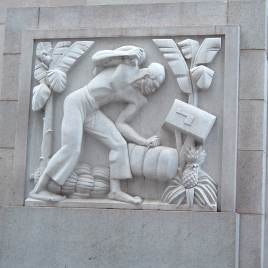
 An Art Deco relief on Philadelphia's 9th and Market Post Office.
Although the elements in Art Deco were far simpler and cheaper than the preceding Victorian styles, it became clear that as buildings were to grow taller, the new economy would not afford the classic elements of style.
The success of the PSFS Building gave developers a unique opportunity. For the first time, an artistic movement was branded specifically for economic purposes. Art and architecture became commodities, not finely crafted luxuries. And the audience ate it up.
 Philadelphia's early 20th Century skyline, thanks largely to the opulence of America's Gilded Age and the Industrial Revolution, was comprised of ornately adorned stone towers. The Great Depression forced developers to seek cheaper ways to build taller. The PSFS Building at the top center was the world's first skyscraper designed in International Style and would serve as the prototype for a century of affordable skyscraper construction.
Art critics tailored the process of interpretation to excuse limited design. Glass curtains were praised for their lack of presence, but those in the design community said nothing of the absent statement made by these unadorned walls. Like modern art, less meant more and we were stunned by the boldness of nothing. And in order for industrial cities to continue to rise, developers needed this trend to continue.
But a century later we continue to interpret meaningless art on behalf of our artists. International Style was invented to oppose capitalism, but its composite construction of cheap materials allowed it to become the ultimate capitalistic blindfold.
People continue to demand less and are willing to pay more for it. While skyscrapers were diluted in order to afford their height, the same practice has been applied to low level and residential architecture in the name of profit. Once architecture meant something in even the most humble of homes, but today’s wealthiest clients have become more concerned with prefabricated amenities than the aesthetic details of their environment.
Throughout the majority of the last century, very few styles have made a statement that wasn’t purely philosophical. A stagnant art scene can be measured anthropologically, and it’s no coincidence that the world’s most exciting experimental architecture can be found in emerging countries like India and China, and in the Middle East.
As the United States struggles to identify as the world’s Super Power, other countries are beginning to experience their own Victorian Gilded Age, which is evident in the skylines of Shanghai and Mumbai and the palaces of the United Arab Emirates.