Thursday, July 23, 2015

A Masterpiece Ahead of its Time

I bought my Volkswagen Corrado in 1999 at a shady used car lot in Portland, OR. At the time I didn't know what I was getting myself into. A recent college grad and a fan of Volkswagens, I was looking for something practical, something like a Golf or a Jetta. 

I didn't know much about the Corrado, but I knew it turned heads. At $6000, my Rado was cheaper than the reliable Golfs and Jettas I was finding. Sure, it was ragged out, but I was young, stupid, and had graduation money burning a hole in my pocket. 

Still, the Corrado eluded me. The son of a mechanic, I was no stranger to quirky cars. I'd dealt with glow plugs, a truck with "FARM USE" spray-painted on the tailgate, and Saab's unfortunately placed ignition. I'd even driven a stick on the column. 

But at the time, to me, the Corrado was just a successor to the Scirocco. A Golf that had been flattened and stretched. Like many others, even as a Volkswagen fanboy, I held the bias that Volkswagen didn't truly design performance sport cars from the ground up. 

I couldn't have been more wrong.


While purists may disagree (or maybe they will agree), the Corrado stands as Volkswagen's one and only true sports car. Yes, the GTI is fast, but it's always been a fast Golf or Rabbit. The Scirocco was a 2x2 available with performance engines, but it also came in varying degrees of bland. 

To date, the Corrado is Volkswagen's only car that was designed with the sole purpose of being fast. It makes sense, even in Volkswagen's storied history of modular practicality, because the Corrado isn't a Volkswagen at all. Built by Karmann, the Corrado was designed as a successor to the Porsche 944, and that is exactly what it is.

Exceptional.

I'll never forget where I was when I noticed the spoiler. Heading downtown on Highway 26, I glanced to a friend in the backseat when I saw it. "I didn't know I had a spoiler." When I got out, the spoiler was gone. Throughout the day it would be there on the highways. At the stop lights, nothing. 

Finally I dug out the manual and there it was, as was the inconspicuous switch under the steering wheel. While just a blip on what this beast was truly capable of, I knew I had found a very unique car, and I knew that this was more than "just a Volkswagen." 

The Corrado's history is a torrid one. Because of Volkswagen's reputation for practicality, when the Corrado was offered, no one wanted to shell out the kind of cash it was asking. Not when they could get a BMW for the same price, even if it was a boring 3-series. People didn't get it.

In 1999, five years after the last Corrado rolled off the assembly line in Osnabruck, people still didn't get it.

Even with its badged grill, people would pull up to me at stoplights and ask, "What is that thing?" When I replied, "a Volkswagen Corrado," I'd get a "No way that's a Volkswagen!" Those who knew better knew what to say, "Damn, man, that's a Corrado! Make the spoiler go up!" 


Fast as ****.

I've driven everything from classic Benz's to Turbo Saabs, and I've never felt as cool as I did at any moment in my G60. And at the time, I feel I never fully appreciated it. Maybe it's because I was a 22 year old idiot, or maybe it's because it was frustratingly unreliable. But 16 years later, I'd give anything to drive it again.

Not long after I bought the Corrado, I moved back to Virginia. My cross-country drive is where I discovered just how powerful she was. Even in its ragged condition, its 100,000+ miles, I got it up to 145MPH driving across Wyoming. She may have fought me through a bumper-to-bumper Hillsboro commute, but cruising above 90 on the Great Plains is where she loved to play, smooth as a brand new Boeing.

I don't think I would drive across country in anything else. 

But the Volkswagen Corrado was more than just a piece of my own humble history, it was also a part of Volkswagen's. Prior to 1989, the car company's history was painfully practical. For decades, the company offered its "Types," essentially varied flavors of the same car with few exceptions. 

When Volkswagen finally broke from its mold, it tried to reinvent itself, but it quickly fell back into bad habits. It found itself offering the same varying incarnations of one model, this time the less successful Rabbit: a truck, a convertible, the Fox, the Vanagon. Sure, they looked different, but Volkswagen was playing the same game. Your car might have come with a bed and a stove, but it was still a Volkswagen.

The Corrado was something new. It bridged the gap between what Volkswagen had been since its inception and the dynamic company it would become. While my G60 deserves its place in history, it was Corrado's VR6 SLC that would really change Volkswagen's game and carry the company into the '90s and beyond. 

The subtle changes between the G60 and the VR6, its wider face, its rounded hood, would ultimately find a more profitable place in Volkswagen's new era, its Golfs and Jettas of the 1990s that led to some of the most popular cars on the road today. 

Still, even as Volkswagen has grown into one of the most successful car companies in the world, they still carry around a stigma of practicality and suffer from a lack of diversity. Maybe some of that comes from the way Americans look at European car companies. While we readily distinguish between a Chevrolet and a Cadillac, we can't look at an Eos, a Phaeton, even a Corrado, without seeing a Beetle or a Jetta. 

That's unfortunate, because when Volkswagen isn't offering reliable predictability, they've managed to make some exceptional automotive masterpieces. 

Sure, a stock G60 might not beat a GTI in a street race, but everyones' eyes are gonna be on the Corrado. 25 years later, it's still got street cred. 

Lately, I've been perusing the pages of CraigsList and eBay for another Corrado. For now you can find a reliable one for around $3000 to $5000, or a mint one for $10,000, that is if you can find one.

Don't count on that lasting very long. With luxury and performance cars from the '70s and '80s finding their place in car shows and the history books, the Corrado - its unique features and short-lived production - is easily a future classic. If you find one, snag it. If you have one, don't let it go. I know I wish I had never parted ways with my fast and furious Corrado.

Will somebody please build the house from Beetlejuice?!

Fans of cinema and history have reconstructed everything from the house in Up to numerous versions of the White House. In the 1990s, FOX and Pepsi built a true-to-life Simpsons house as part of a promotion. Someone even commissioned a nearly identical replica of Grey Gardens, at least its facade, inspired by the HBO movie.


From Psycho to Poltergeist to Christmas in Connecticut, a movie's architecture is as much a character as anyone in its cast. But with some notable exceptions, the houses on the screen are often as fictional as their cast-mates. You'll find the house from People Under the Stairs in Los Angeles a short drive from American Horror Story's "Murder House." But if you were to step inside, you'd find unfamiliar - albeit grandiose - architecture. 

The logistics of filming a feature anything inside a real house are complicated. That is unless you're filming at Biltmore Estate. Even greater creative license is taken with sitcoms, especially staged laugh-track sitcoms from the '80s and '90s. I always wanted to know what was on that fourth wall of the Keaton's living room...or the Seaver's, or the Sheffield's, or the Huxtable's. And how many of you only use three sides of your dining room table?

Every "living room" in the '80s and '90s.

Still, we remember those houses as much as we remember the characters that lived in them. Artist Inaki Aliste Lizarralde took this inspiration to an obsessive level by drafting quality floor plans of popular sitcom locales. 

So that begs the question: if artists are capable of creating blueprints for our favorite fictional homes, why hasn't anyone built the house from Beetlejuice?

For a multitude of reasons, the Maitlands' house - both before and after its bizarre redesign by the Deetz's - is by far my favorite fictional house in every way. For one, it reminded me very much of an aging farm house a few miles from the farm where I was raised. I also had my own miniature town in my parents' basement, complete with little cars and little people. After seeing Beetlejuice in 1988, I reconfigured some of the houses into an uncanny representation of my own home town of Mt. Crawford, VA, similar in size to the fictional Winter River, CT. 

The only things missing were a cathouse, ghosts, and of course, the Maitland's Victorian Gothic perched atop a hill. If I could have fashioned a scaled Otho Fenlock in a kimono, I probably would have made it happen. 

Despite my long running fascination with this fictional home, I only recently discovered the house itself was a set with only three walls. It shouldn't have come as a surprise. The house didn't make a lot of sense. 19th Century farmhouses were usually built on low ground, not atop hills. The home's design was deliberately cartoonish, clearly the playful work of Bo Welch, who also worked with Tim Burton on Edward Scissorhands. 

"My whole life is a darkroom. One. Big. Dark. Room." -Lydia Deetz

But the 12 year old inside of me, the one who watched Beetlejuice at the Roth 1-2-3 almost 30 years ago, had always held out hope that it was, in fact, a real house. And that I, of course, would someday live in it. 

Perhaps someday someone will. According to Winona Ryder, a sequel is coming. Tim Burton confirmed the rumor. Very little is known about the sequel yet, but the fact that the word "sequel" has been floated means we won't get another worn remake. And let's face it, there is no reason to remake Beetlejuice. Special effects? Why bother? Its Burton-esque effects are part of what made the movie so great. 

Can you imagine Beetlejuice CGIed into Adam Maitland's tiny-town? The scale model's grass was clearly made from household foam padding, dyed green. These details (or un-details) are what make Tim Burton such an artistic genius. Even when special effects are available, he does something playful that forces us to use our imagination to fill in the gaps.

With 2018 marking the film's 30th anniversary, a three-decade gap between the then and now offer plenty of material to play with. How did the Handbook for the Living and the Dead work out? Did Ms. Argentina finally call number 9,998,383,750,000? How will they address the unfortunate loss of Otho's brilliant Glenn Shadix?

Reboots are cheap and easy, and often a downright narcissistic way for a new director to put an unwanted spin on something someone else already perfected. I'm looking at you, Stepford Wives.

But amending long dormant stories is uncommon. In fact, Twin Peaks' Season 3 is the only instance I can think of where writers, directors, and a large chunk of the original cast have agreed to return more than two decades later to reprise their roles. Sure, Carrie 2: The Rage was technically a sequel, but its only veteran might as well have been a cameo, and SPOILER ALERT...


...she's unceremoniously killed off when Carrie's "rage" sends a fire poker through a peephole. Seriously, why do people in movies always look through the wrong side of a peephole? 

But as bad as Rage was, it was an earnest attempt to honor a classic without rewriting it. That kind of blaspheme would have to wait until 2013.

If Peaks and Beetlejuice prove successful, we may see a new trend in cinema revisiting long forgotten story lines rather than simply rebooting them. One can hope.

As for Beetlejuice's three-sided prop that inspired my fantasies and helped fuel my passion for macabre architecture, it will undoubtedly need to be rebuilt. Maybe this time Burton will opt for four walls and plumbing: a real house that can be actioned off to one of Beetlejuice's biggest fanboys.


However it happens, I'll be taking a road-trip to East Corinth, VT during production. "Oh, hey, Winona, nice to meet y -WHOA, THERE'S THE HOUSE!"

Sunday, July 19, 2015

Preserving Fake History

In the mid-20th Century, when one of Frank Furness's many gems was torn down in the name of Colonial revitalization, residents went nuts. At least the locals who held on to a city that was about to go the way of the Edsel. 


Dwindling in numbers, we have those people to thank for the Philadelphia we know today. One without a South Street Expressway. One with a robust downtown. And a city that didn't become "another city with some old stuff."

But try as they did, Frank Furness's Penn National Bank met the wrecking ball in the name of Colonial nostalgia.

The bank was demolished and the Graff House was rebuilt. Unlike the homes of Benjamin Franklin and George Washington, both standing as ghost structures, the Graff House was fully rebuilt in the 1970s. Dubbed the Declaration House, the home is nothing significant. Had it been standing in the mid-20th Century, it might be a unique relic amid Market East's booming retail transformation. But as it stands, it's fake.

Rarely open and mind-numbingly boring, the Graff House, named for a longtime owner of a nonexistent house, saw little more than 1000 visitors last year. Two blocks from the Liberty Bell, the Shirt Corner saw more action. But those behind the Graff House are hoping to capitalize on the burgeoning Market East strip by renovating the beleaguered structure. 

If you need a visual for pork, the Graff House is it. 


What happened at the long-gone house at 7th and Market is sketchy. Those behind the Graff House claim Jefferson drafted the Constitution there. Between Virginia and Philadelphia, Jefferson did draft the Constitution. But again, even if he wrote one draft at 7th and Market, the building that stands isn't real. Nothing happened there. 

Yet this historical attraction, fake as it is, is trying to get $6-7M it claims is needed for restoration. 

Let's face it, even in its condition, the Graff House is a Society Hill home. On a good day, a large house in one of Philadelphia's poshest neighborhoods might fetch a couple million dollars. Why then has the park service estimated repairs at a price that could easily build five more?

$6-7M is staggering. The city says that the property is worth about $1.5M, and much of that is just land. The Graff House isn't a museum on par with the Barnes or the National Aquarium, it's a humble house museum. Built in the 1970s, this is just a house accommodating a few thousand square feet, if that. Its renovation estimate should be on par with a suburban McMansion in Cherry Hill.

If it really needs more than $6M in renovations, tear the thing down and build something worth $6M. 

Promising Changes for the Hale Building

The Divine Lorraine isn't the only Willis G. Hale masterpiece to be passed around from developer to developer, begrudgingly prompting the phrase "I'll believe it when I see it."

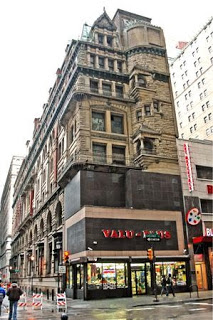
The Keystone Bank Building, otherwise know by its' architect as The Hale Building, at Juniper and Chestnut has been an uncertainty since its unremarkable Valu-Plus closed a few years ago.

The bizarre building, which has been hacked up and altered about as many times as it's changed hands, is a pedestrian favorite amongst both locals and tourists. For years its upper floors served as a gay bathhouse. Hidden City showcased a spectacular walkthrough photographed by Michael Burlando, offering us a glimpse at what so many wonder: "What the hell is up there?" 

Turns out, quite a bit of odd history but not much worth anything to developers. When scaffolding flanked the sidewalk, many had hoped that work had begun. Unfortunately the crumbling building had spawned fears in the city's office of Licenses & Inspections, and what looked like a construction site was just a safety precaution to keep concrete and stone from falling on passing by Instagrammers. 

But if all goes according to plan, the Hale Building will be bought by Brickstone Realty Company, it's upper floors converted into offices with two restaurants on the ground floor. 

Sure, as is the case with the Divine Lorraine, we've heard this all before. But Brickstone Realty isn't just one of the more experienced developers in the region, they also have a knack for acquiring uniquely historic properties and salvaging what makes them so special. 

To put that into perspective, Brickstone renovated the Wanamaker Building and Lit Brothers on Market East. 

Jacob Adelman of the Philadelphia Inquirer put together a great retrospective on the building's genealogy of tenants, a family tree that reads like a history of modern Philadelphia, all of which tell the kinds of stories that could write their own film noire. 

With Chestnut Street's redevelopment and emergence as a shopping destination and Market East being rebranded for the first time since the Gallery at Market East opened, the Hale Building - modest in size - has always been a no-brainer. It's just been silently laying in wait for the right developer with the right ideas. 

Friday, July 10, 2015

Want a "Tiny House?" Philadelphia's had them...for a while.

I've been obsessed with the Tiny House movement ever since it carved out its own corner of the architectural blogosphere. They're freaking adorable. If you disagree, or don't know what I'm talking about, take a quick look.

While there's no current standard for what empirically defines a Tiny House, the movement was born following the housing crisis of 2007 and encourages living spaces of less than 1000 square feet. In Philadelphia that might seem irrelevant. In much of the Northeast, 1000 square feet is plenty. In Center City or Manhattan, it's downright decadent. But the square footage threshold is far from set in stone, with many Tiny Houses taking up 400 square feet to as little as 80. 

It's hard to look at this without saying "totes adorbs."

I get it. They're "green," they're whimsical, and theoretically cheap. Ever since I saw the first Tiny House grace the silicon screen, I wanted one. Cutting ties with the trappings of materialism and nostalgia, eliminating clutter and living in my city, not my house, sounds utterly liberating. Then, as I was creeping down my pie staircase and stubbed my toe on my bike, I realized, I already live in one.

The Tiny House movement didn't originate in 2007. It emerged - at least in the United States - about 300 years ago in Philadelphia, New York, and Boston. These were known as Trinity Homes, usually consisting of one room per floor, a dirt floored kitchen in the basement, and a privy in the rear. It wasn't an altruistic movement. Our Founding Fathers may have been idealistic in their own way, but their dedication to environmentalism and carbon footprints ended with the fact that electricity and indoor plumbing hadn't yet been perfected. They were imperialists, industrialists, and at the time, some of the largest land owners in the world.

They built big, and for the next 200 years would continue to build bigger. The Tiny House movement of yesteryear was simply a place to store their human property, i.e. indentured servants and slaves. 

Centuries removed from the horrors of cramming families into these Trinity Homes, the immigrant tenements they morphed into throughout the early 20th Century, Philadelphians have developed a renewed interest in these houses. In fact, some of the most sought after homes in Philadelphia - those along Elfreth's Alley - are Trinities. 

One of America's first "Tiny Houses."

Some have been meticulously restored, others have been largely modernized or combined. Still many retain the bare minimum: modern plumbing and electricity, but few frills. The most desirable are throughout Washington Square, Society Hill, and Queen Village, while countless others are full of hipsters in Fishtown the Italian Market. 

When I moved to Chinatown's Winter Court about seven years ago, I got rid of my sofa, traded my fat-backed TV for a sleek Mactop, and put the heirlooms in a storage unit not much smaller than my floor-plan. And it was liberating, for a while. 

Tiny House living is a challenge, but in the regions that embrace the ideal - largely the Pacific Northwest - they work with ample space. In the dense cities of the Northeast, a tiny house - whether new or old - means vertical living. Unless you obsessively plan every second of your day, or are a complete slob, you're going to find yourself exhausted by your hourly game of Chutes and Ladders and end up with a pile of shoes and toiletries stacked at the foot of your stairs. 

The reality of our living spaces is that they are spaces in which we live. And that becomes painfully apparent the first time you fall down the stairs or leave a stack of mail a little too close to the stove. The oven is a great place to store boxes of cereal, but you'll never forget the smell of roasted Cap'n Crunch after preheating the oven for the Thanksgiving quail you're going to eat on tray tables with the two other people you can fit in your living room.

Don't get me wrong. The Tiny House movement is an astonishing one, and a part of me still wants to live like Frodo Baggins. Or, I should say, a part of me still enjoys living like a Hobbit. That's why I've stayed on Winter Court for seven years. 

But it's a daily effort. Even the smelliest hippy can wind up feeling like a hoarder after a few years in 500 square feet of vertical living space. You begin to make unusual considerations, like whether or not you want to cook that cajun catfish knowing you'll be smelling it while you sleep. And not to sound crass, but with only 500 square feet, you're never very far from the toilet. 

In a nation where the average home can easily grow to 2000 square feet and beyond, the movement, and Philadelphia's adoration for Trinity Homes, makes its point. Modern homes have become cheaper and cheaper to build, and it's easy to say, "sure, give me the extra bedroom or that Man Cave" without considering the eventual cost in utilities. Modern Tiny Houses allow a higher quality craft to be invested into a smaller space. Trinity Homes allow for savvy improvements that would otherwise be lost in the cavernous space of the average modern home. Money otherwise put into suburban expansions can be invested in better materials, insulation, and pricier, more efficient appliances. 

Still, as trends go, capitalists understand their market and the market for Tiny Houses is growing. What started out as a quirky campaign for the few who understood the philosophy behind these houses is evolving into one trading grassroots idealism for profit and panache. Today, many of these Tiny Houses, some essentially well designed modular homes, can cost more than a suburban McMansion, and that's not including the land. As for Trinity Homes, if you truly want to go-green, remember that the greenest house is one that's already standing. 

Thursday, July 9, 2015

UNESCO World Heritage City

You probably saw the news today and thought, "that's pretty cool, but what's the UN's World Heritage Cities program?" If any media outlet had bothered to refer to it as its umbrella acronym, UNESCO, it is likely more familiar. 

The news? Philadelphia is in line to be the United Nation's next and only city in the United States to be designated a citywide UNESCO site. That's significant. Though the list of UNESCO's World Heritage Cities is long, its most prominent are places like Paris, Rome, Madrid, and Istanbul. That's good company for Philadelphia, especially in a list devoid of the United States' usual contenders: New York and Los Angeles. Even where history plays a significant role, Boston didn't make the cut.


While you might think of Easter Island and Stonehenge when you think of UNESCO, its' Organization of World Heritage Cities (OWHC) are held to the same rigid standards. To be in the running is honorable. Considering the national media's current love affair with Philadelphia, we're already set to see record tourism in the coming year. UNESCO and its OWHC might be too obscure to add to those numbers, but it may be significant to those who've already scheduled a visit. 

Friday, July 3, 2015

A Disaster Only God Himself Could Orchestrate

As much as I've come to love Philadelphia, I will admit, it's often a place that infuriatingly makes no sense. It took this farm raised Southerner a good decade to finally learn to tune out the Northeast Rage and another few years to find my own. 

It's the kind of place where convenience stores form "three separate lines" instead of funneling the next customer to the next available register. It's the kind of place where every business will always have one door locked for no apparent reason. It's the city that says, "sir, we're closing in 15 minutes." If it's going to take you more than 15 minutes to find me a headlight for a '97 Civic, I'll order it online. 

The people certainly don't help. When I first moved to Philadelphia, I was a bit surprised it wasn't as dirty as its reputation. That's not to say it's clean, but for all the bitching and moaning about the place dubbed "Philthy," it's only slightly dirtier than New York and cleaner than quite a few other cities. I was quickly corrected, "it's not the place, it's the people." I was told that by a local.

And it's true. It's a volatile place, one in which you're hard pressed to find personal accountability. The most basic misunderstandings end in screaming matches on heavily trafficked streets and the biggest end in the courtroom. "It's not my fault" should be the city's motto, and while we're at it, add it to The Garden State's license plates as well. You could get mowed down by a white BMW headed for the Ben Franklin Bridge running a red light and it'll still be your fault, even if you're sitting in your backyard. And while we're on the subject, it's apparently okay to run red lights, as long as you honk your horn. 

Of course it's not just the small annoyances that carry no rhyme or reason. They're likely the trickle-down fallout of city and state bureaucracies that tend to lob a bunch of red rubber balls across the white line and hope they hit a thing or two. Traversing Philadelphia is a lot like driving across Logan Square: close your eyes, clench your butt cheeks, and hope you come out the other side in one piece. 

That brings me to Philadelphia's next up-and-coming ass ache. I'm not talking about tomorrow's Fourth of July celebration or the game of human bumper cars that is the Pennsylvania Convention Center on any given weekend. I'm talking about September's Papal visit. 

More than two months away, and I'm already on edge. That's not uncommon. Given my aforementioned rant, I frequently play out argumentative scenarios in my head about things that never happened, because I know they would happen and the unnerving ways they'd play out. But this visit really is going to be a nightmare on par with nothing the city has ever seen, short of a Victorian era influenza outbreak or perhaps the American Revolution. 

If you've ever read about the city's disastrous Bicentennial celebration or the last Papal visit, think that, times infinity. 

Why? Well I doubt you even have to ask. The city is projecting a swell of 2 million pilgrims to flood Philadelphia the weekend on September 26th. While City Hall, transit authorities, and the Philadelphia Police Department seem to be working diligently on making his visit a safe one, specifics are sparse and rumors abound. For one weekend, Philadelphia will grow in population to the nation's third largest, that is if its 1.5 million residents don't flee beforehand. 

But fleeing could easily become one of its biggest problems. Center City roads will be closed, SEPTA's subways will be operating at minimal stops, regional rail will be reserved for those who purchase special passes, and, get this, Center City might even be fenced in with an 8 foot wall. 

Yes, you read that correctly: Center City could be fenced in by an 8 foot tall wall four miles long. 

If you've ever seen 1981's Escape from New York, you've probably already booked a bunker in Montana and planned your exit a week in advance. Pomp and circumstance can only do so much. Philadelphia's September of 2015 is going to go down in history as the dystopian fantasy it's setting itself up to become. 


Get Out or Get Ready

Part of that won't be due to the crowds, the complex travel that will need to be arranged for visitors who've already booked hotel rooms outside the Papal Wall, or even the security that's gearing up to make Marshall Law look like Mayberry. It's also because Philadelphia and the United States aren't the same places they were the last time we received a Papal visit in 1979. The Pope will be in town for the World Meeting of Families, and the Supreme Court just ruled that America's truly legal definition of "family" includes quite a few who clash with some of the Catholic Church's aging ideals. 

Two weeks ago, it seemed that every reasonable gay, lesbian, or bisexual Philadelphian would have been ready to hightail it to Rehoboth Beach or Asbury Park for the weekend. And that probably would have been the case had Archbishop Charles Chaput not given gay and lesbian families a formal unvitation. Without going into the brazenly hypocritical statements made by Chaput (think phrases like "welcoming environment" paired with dozens of social caveats), he essentially said gay and lesbian families are welcome, as long as they don't point out why they're not welcome. 

Naturally this didn't just ruffle feathers in Philadelphia's LGBT community, but also any watchdog whose ears perk up whenever a religious dictator attempts to pull rank. And that's exactly what Chaput has done, and he probably would have been better off barring gay and lesbian families, or simply keeping his mouth shut. 

I don't know how things work in the Vatican or behind the doors of his Basilica, but closing roads, shunting transportation services, even building a goddamn wall on the Catholic Church's behalf doesn't make Pope Francis or any of his underlings Supreme Leader for the weekend. We still retain our Rights to Assemble, Speak, and Protest. For the first time since Roe v. Wade, the Catholic Church has found itself at odds with the Supreme Court of the United States, and its timing won't bode well for any hope of a purely peaceful event. 

Personally, I'll be in Delaware. For me, Catholicism has about as much clout as Scientology or those building "Little Salt Lake" across the street from the Basilica of Saints Peter and Paul. I won my battle, and my church is the United States Constitution. But for those fighting for additional rights within the private confines of their church, for legitimate recognition within their spiritual domain, they have every right to shout their beliefs from the Parkway, and I have to imagine the Parkway's namesake might be right there beside them. 

They'll just have to climb an eight foot wall and walk a few miles to get there.