Showing posts with label Schuylkill River. Show all posts

Tuesday, February 16, 2016

Marketplace Design Center

With the Schuylkill River transforming into "Downtown Philadelphia" before our eyes, PMC Property Group planning to transform the Marketplace Design Center into a 22 story office and residential complex. If you're not sure where that is, look for the whale mural facing the river. 


Given Cira Centre, One Riverside, and CHoP's Schuylkill Avenue expansion, it isn't the most ambitious design. On its own, it's not bad. But pictured from another angle, one from the south in which the PECO Building would be in view, that's an awful lot of black paneling and dark windows. Paired with the river's emerging crystalline skyline, Market Street might feel like Happy Hour on the Death Star. 

That's not to say a break wouldn't be bad. 

Every new building blooming from the banks of the Schuylkill looks like a shard of quartz. Handsome buildings on their own, but grouped together they look like the Starfleet Academy. Currently complemented by the Art Deco 30th Street Station and IRS Headuarters, even PECO's foreboding facade, they could use a bit more to dull the monotony, and 2400 Chestnut isn't cutting it.

In fact, giving the boomtown the riverfront is becoming, it might be time for 2400 Chestnut to think about skinning its facade in something a little more interesting. Flanked by soon-to-be Darth Vadar's condo and my pipe dream that Mandeville Place will ever return, 2400 Chestnut is the riverfront's lone pimple. It might soon be time to OxyCute it. 

Sunday, April 13, 2014

How One Crosswalk Could Bring Hundreds More to the Zoo

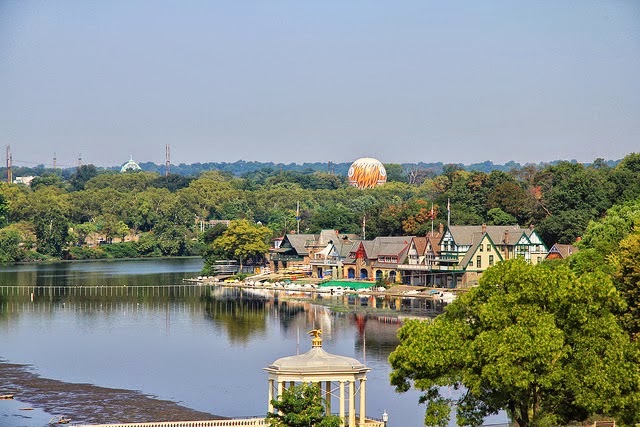
The Philadelphia Zoo sits just upstream from Boathouse Row
On beautiful days like today, thousands of locals and visitors take to the Schuylkill River Trail. Many complete the full "Schuylkill Loop" which goes all the way to the East Falls Bridge and back down West River Drive. The entire experience is one of our city's best assets.

What could be included in the journey is the Philadelphia Zoo. Walking to the Zoo from Center City is a breeze. The Girard Avenue Bridge is a short walk from Boathouse Row, and the bridge carries pedestrians straight across to the Zoo. So why aren't hundreds of these recreationalists finding themselves wandering into the Zoo on their weekend strolls? Because walking to the Zoo from Center City isn't the breeze it should be.

The Girard Avenue Bridge does have a staircase to take pedestrians to the street from Kelly Drive, but there are two problems. The lower portion of the staircase is gone. It's an easy enough hill to climb, but the other obstacle is even more difficult to overcome: Kelly Drive.

Only those with a death wish would dart across Kelly Drive, and they do it all the time, either to access the bridge or to park on the east side of the Drive.

It's a simple solution: a crosswalk. There's no crosswalk between Sedgley Drive and Fountain Green Drive, and Girard lies exactly in the middle. But the one simple solution could do so much more than just get people safely across the Kelly Drive Freeway.

Pedestrians who often ignore the Zoo as a need-to-drive endeavor can easily find themselves strolling across Girard and into the Zoo. That's money. Also, those on the Schuylkill River Trail would be able to access the Glendinning Rock Garden, the lower Fairmount Park's greens and mansions, and reach Centennial Park and the Belmont Plateau on foot. Residents near Girard Avenue, cut off from the Schuylkill River by Kelly Drive, will be able to reach the river in minutes.

Saturday, February 2, 2013

Delaware River Debacle

PlanPhilly just reported that engineering will soon begin on a new eight acre park capping I-95 and extending to the waterfront, and the rendering looks pretty fantastic.


Unfortunately, the headline is a bit of a misnomer, and the rendering a bit misleading. By "engineering," the Delaware River Waterfront Corporation will be performing a $400,000 study to determine a master plan and to begin discussions with private developers.

Sound familiar? That's because it is.

The DRWC has been engaged in multiple studies in the ten short years I've lived here. In fact the city has been trying to solve the Delaware River debacle ever since it cut it off from the city in the 1970's.  

A quick Google search brings up countless "Master Plans" and fantastically grand renderings of a new Penn's Landing brimming with condos, amusement parks, museums, even an aerial tram carrying Philadelphians across the river to Camden's waterfront, which inexplicably remains more successful than ours.

Why the DRWC continues to tease Philadelphians with these master plans and exciting proposals (if they can even be called that) is a mystery to me. Part of me wonders if the powers that be at the DRWC want to see how long they can keep getting paid to push paper.

After all, any amateur architecture nerd with a laptop and Photoshop can put together a lavish rendering of a new and lively Penn's Landing. That gets passed around the local blog circuit, excites and pisses off neighbors, while those employed by the DRWC get paid to watch the show. A few months later, the DRWC passes off a new "engineering" effort to PlanPhilly and spends the next year working on the next master plan.

Thirty years later, we still aren't asking why?

We've managed to put tens of thousands of recreationalists on the Schuylkill River in the last decade, and while it's a much smaller river with fewer logistical obstacles, the city has been actively struggling with Penn's Landing much longer. In fact, given Philadelphia's historic reputation for pipe dreams, the successful changes on the Schuylkill River are mind boggling.

Part of that success might be in the piece meal approach taken on the Schuylkill River. Instead of an overall master plan requiring billions of dollars and speculative investment, Boathouse Row, the Philadelphia Museum of Art, Waterworks, the Schuylkill River Development Corporation, the Friends of the Schuylkill Banks, and the Schuylkill River Trail are all working on smaller, individual projects and seamlessly wove them together into an organic and unintentional master plan that no CAD hack ever saw coming. 

It's true that those investing in the Schuylkill River are working with existing assets that the Delaware River lacks, but that doesn't change the fact that the approach that's failed the Delaware River for the past thirty years still doesn't work.

In fact that lack of assets is what the DRWC needs to target, not tax funded improvements to a burden no one wants to walk to. Pedestrianization and interstate caps are great, but they're supplementary improvements at best.

Parks are rarely destination attractions. The Schuylkill River's proximity to Center City and the PMA serves as its own destination attraction while the Delaware River sits isolated and sparsely populated. We need to bring Center City's built environment to the Delaware River, not just its sidewalks.

Without new residents and shoppers on Delaware Avenue, any master plan is only going to inhibit the organic creativity on the part of developers and architects who have a shot at bringing those people to the water.

Thursday, December 9, 2010

The Mighty Ducks

Washington Square West has something to say! Well, 24 of its residents have something to say, er, maybe 22.

Brownstoner picked up on a survey put out by the Washington Square West Civic Association in which they found that a whopping 92% of their readers opposed moving the Ride the Ducks tour to the Schuylkill River. As if the Ducks have anything to do with Washington Square West - which hugging Broad Street is about as far from any river as you can get in Center City - that "92%" was of 24 people. Not a very groundbreaking sample, particularly when you consider that 92% of people who frequent community organizations' websites are looking for something to whine about.

I love the Schuylkill River and all of its parks. If anything I would like to see more boats, amphibious or not. When something succeeds it is bound to grow in popularity, and we can't expect it to be reserved for a chosen few. Tourists mean this city is getting better, and they mean more money can go towards more potential successes. The Ducks are going to be doing down the river, not down the Schuylkill River Trail. They'll also be adding a ramp into the river which will allow day sailors to enjoy the lower Schuylkill River without having to dangerously navigate the Delaware and South Philadelphia Navy Yard.

Friday, November 5, 2010

WaterMagic and Lots of Tourists

The Schuylkill Banks success story is about to get a little shot of caffeine. WaterMagic is a Philadelphia installation developer that combines water screens, image projection, robotic fountains, and solar power to create visual spectacles.

In addition to solar powered fountains, a screen of water would be used to show movies for evening events on the Schuylkill Banks.

As Ride the Ducks prepares to reconfigure their route to use the Schuylkill River instead of the Delaware, the Schuylkill Banks may become more of a tourist attraction than a place for residents to enjoy a lazy, sunny day.

Unfortunately the success of the Schuylkill Banks isn't free. While Okies* might be headed to the river to watch a movie projected on a 100 foot wall of water, those Okies are paying to keep that park clean.

While cheese steak wielding tourists might not be ideal to the Fitler Square sunbathers, the harsh reality of an urban success story is that it attracts visitors.

The increasingly popular Schuylkill Banks

Nutter might be seeing dollar signs, but Ducks, movies, and magic water pay the bills. Much needed improvements to the Delaware Waterfront could one day be built on lessons learned from her little sister.

Fairmount Park is huge and the Schuylkill River Trail goes all the way to Phoenixville. An advantage urbanites will always have on our tourists and suburbanites is our ability to find hidden oases in the heart of the city. The Schuylkill Banks is an urban success story but it's not a secret one. It was only a matter of time before its popularity went viral.

Enjoy it for what it is. But if you want a place to relax, I suggest
the Ellen Phillips Samuel Memorial Sculpture Garden.

*An Okie is the common term for one from Oklahoma.

Thursday, November 4, 2010

Ellen Phillips Samuel Memorial Sculpture Garden

Between Kelly Drive and the Schuylkill River just south of the Girard Avenue Bridge is a frequented, yet often mysterious sculpture and fountain garden. The Ellen Phillips Samuel Memorial Sculpture Garden was commissioned from 1933 to 1961.

Settling of the Seaboard

Ellen Phillips Samuel left a bulk of her estate to the Fairmount Park Art Association when she died in 1913, specifying that it be used to create a series "emblematic of the history of America." Upon her husband's death in 1929, these funds became available to the Art Association which decided to depict chronological events in American history through sculptural design.

Spanning the Continent

Hundreds of artists were sought from around the world during three International Exhibitions at the Philadelphia Museum of Art in 1933, 1940, and 1949.

The Quaker

Work was completed with the dedication of the Samuel Memorial in 1961. The sculpture gardens are divided into three landscaped terraces separated by gardens and fountains.

The Birth of a Nation

The Central Terrace was the original terrace and includes Spanning the Continent by Robert Laurent from 1937, Welcoming to Freedom by Maurice Sterne from 1939, The Ploughman by J. Wallace Kelly from 1938, The Miner by John B. Flannagan from 1938, The Slave by Helene Sardeau from 1940, The Immigrant by Heinz Warneke from 1940, and The Spirit of Enterprise by Jacques Lipchitz from 1950-1960. The Spirit of Enterprise was moved to the Central Terrace in 1986.

Welcoming to Freedom

The South Terrace was the second to be assembled and includes Settling of the Seaboard by Wheeler Williams from 1942, The Birth of a Nation by Henry Kreis from 1943, The Puritan and The Quaker Harry Rosin from 1942, and The Revolutionary Soldier and The Statesman byErwin Frey from 1943.

The North Terrace was the final garden to be built. Originally two major bronze sculptures were to represent "social consciousness". Social Consciousness and The Spirit of Enterprise were designed by Jacob Epstein and Jacques Lipchitz but were too massive to both fit in the North Terrace. Social Consciousness was installed at the Philadelphia Museum of Art's western entrance and the The Spirit of Enterprise was installed as the centerpiece of the North Terrace until it was moved to the Central Terrace in 1986. Sculptures included in the North Terrace are The Preacher by Waldemar Raemisch from 1952, The Poet by José de Creeft from 1954, The Scientist by Koren der Harootian from 1955, The Laborer by Ahron Ben-Shmuel from 1958, and Titles Unknown: Eye and Hand by J. Wallace Kelly from 1959.

The Miner
The fountains are no longer functional but the sculptures and grounds of the gardens are relatively well maintained. As of now, no effort has been made to restore the fountains that separate the terraces. But as more and more people flock to the revitalized Schuylkill River Trail, one can hope that an increased interest in the history and restoration of the Ellen Phillips Samuel Memorial Sculpture Garden is an optimistic possibility.