Developer, Bart Blatstein, ever the optimistic visionary behind Northern Liberties' Piazza and a grand proposal for Broad and Washington, isn't afraid of diving in headfirst. If you thought his proposed casino in the old Inquirer Building was outlandish, the next stop on Blatstein's Philadelphia Dreamin' tour won't disappoint you. Along with Joseph Volpe, Blatstein has agreed to purchase the Delaware Station power plant from Exelon. The plant is just north of Penn Treaty Park in Fishtown. Volpe's Ceachaphe Event Group organizes lavish wedding receptions throughout Philadelphia, and the pair plan to capitalize on the power station's unique architecture, cavernous interior, and prime location. Housing two hotels, each with its own massive ballroom, the venue might even come with its own marina. It's a winning plan for both the historic building and the neighborhood, but its location on the Delaware River might be its most positive attribute. For decades, Philadelphia has struggled to embrace our rivers. Park improvements along the Schuylkill have transformed residents' relationship with our waters, and the Delaware River Waterfront Corporation is struggling to follow suit.
But unlike cities such as Chicago or Seattle, heavily developed along their shores with both parks and skyscrapers, Philadelphia's developers have largely shied away from marketing waterfront properties. With the exception of Manayunk, the Delaware and Schuylkill Rivers are parks, ports, or parking lots. Where the built environment does meet the shores, it's vastly suburban or abandoned. Perhaps the financial failure of Waterfront Square and the massive outpouring of resistance against SugarHouse Casino have discouraged developers from getting their feet wet. Redeveloping, and rethinking the Delaware Station might signal the beginning of a new trend, one our rivers should be eager to receive. As the DRWC continues to improve the river's public space north and south, turning on the lights above Penn Treaty Park helps break the mental barrier between Center City and points north.
Five days ago, the New York Times declared Philadelphia the #3 place to go in 2015, just behind Cuba and Milan. It wasn't an isolated fluke. Conde Nast recently published a reader survey that elected Philadelphia the world's second shopping destination, only outranked by Barcelona. Late last year Forbes called Philadelphia one of three great cities for solo travel along with Boston and Milan.
The weight of this praise may be hard for some locals to comprehend. We live this city every day. Like a New Year's resolutionist staring at a scale, we don't always recognize the heaping improvements this city has made in relatively recent years. But the New York Times, Forbes, and Conde Nast have pointed out the apparent fact that, yes, Philadelphia's world class vitality has been resuscitated and we're charging headfirst at becoming the nation's premier city.
"The City of Brother Love is having a moment." - Forbes
Looking at Reading Terminal Market and Old City boutiques, even chains as unique as Uniqlo and Century 21 or as benign as Nordstrom Rack, Conde Nast explains why hardcore fashionistas are heading to Philadelphia's tax-free cash registers. And the Times and Forbes are telling them why they need to stick around.
Dated storefronts are being replaced with exciting window displays and an endless supply of local restaurants, pubs, and entertainment venues. Faster than you can say "beer garden," you could have your hand wrapped around a local lager on nearly any block in Center City.
But it doesn't end with a few listicles. If Philadelphia can earn high marks for shopping and travel, just imagine where we'll land when the most cynical amongst us are finally willing to admit we deserve it. Let's face it, we're a pessimistic bunch. Despite our fierce loyalty, we tend to take praise like a Greek yia yia at Easter. We hide our pride behind burden.
That doesn't matter. In fact, it's charming that our city has a collective personality. But the influx of travel, growing population, and new destinations are bringing more. Park improvements along both rivers are signaling neighborhoods to bring their A-game. Once a pipe dream, the proposed Reading Viaduct Park is no longer inching towards reality, it's actually happening.
And we're not just following in the successful footsteps of other cities. From BYOs to our universities and hospitals, Philadelphia is trailblazing emerging industries and ideas.
CHoP will soon be rising above the South Street Bridge and University City's skyline is about to be home to the city's sixth tallest skyscraper. The Schuylkill Banks is on its way to Bartram's Garden on the west bank of the river. We're using smart urbanism to build tall and embrace pedestrians, connecting commuters and challenging what we consider "downtown."
The Girard Trust Block is currently one of the largest redevelopment projects since Liberty Place gave our city a skyline, and it's begging the Gallery at Market East to get in line. And the Gallery has responded.
We're pumped up like Danny Bonaduce, growing fast with a subtle hint of roid-rage.
Things are snowballing, not because national publications have decided to recognize us, but because we gave them something to look at. No longer the Oldsmobile of America, this is not your father's Philadelphia. So move over Chicago and San Francisco, there's another big player in town. And with thousands of acres of affordable, sustainable, urban real estate north, south, and west, we can house out-priced refugees from New York and D.C. for decades.
After the epidemic of "manspreading" was brought to our attention by New York's Metropolitan Transit Autority, Philebrity and Gothamist have finally called attention to the equivalent for us urbanites who traverse the city above ground: "sidewalkspreading." What I've always called "double-parking," sidewalkspreading is what it sounds like. You've seen it, and you've cursed it. You've been behind it, in a hurry or not. You've come face to face with them, pushed to the curb or through the middle of a group perplexed by your mere existence. Sometimes it's a family from Nebraska ogling the skyline. But others should know better. Stuck behind a hoard of tiny hipsters who inexplicably manage to monopolize the entire sidewalk with a collective weight of 150, you think, "how?" Or a tragic incarnation of Carries and Mirandas who haven't yet learned how to walk in their Manolos, "you must know better." And sometimes it's just one with a Starbucks cup in one hand, a cell phone in the other, and a Michael Kors granny bag draped at the elbow like she's Victoria ****ing Beckham. You know who you are and you all know better. End the sidewalkspreading.
It looks like Mom's Organic Market will be moving into the 11th Street component of the massive East Market project currently under development on the Girard Trust Block. While it's great that Philadelphia will finally have a supermarket on par with Whole Foods, or even SuperFresh, closer to the core of its residents, what's even more exciting is the facelift the former Family Court Building will receive. Once a warehouse for Snellenberg's Department Store, the old Family Court Building is faded and its facade is cracked and worn. Rather than restore the building's exterior, developers will be refacing it to include modern elements and large windows. The new skin could have been as dramatic as that at Goldtex Apartments, but given the sum of the parts of the overall project, it doesn't have to be. The high-rise that will be anchoring 11th and Market looks sexy enough to carry the entire block. By slicing the block bound by Market and Ludlow in half for a pedestrian promenade, East Market isn't afraid of sacrificing land for a quality experience. They're carrying that theme over to the old Family Court building by opening up a good amount of the building's square footage to the outdoors. Center City's most exciting project (sorry, CITC) keeps getting more exciting.
I was just gushing about the recent improvements and proposals for Vine Street, namely the Church of Jesus Christ of Latter Day Saints' decision to embrace one of the street's least desirable lots for a residential high-rise. Others are following suit. What's ever better, the development will replace yet another surface lot that scars the cityscape leaving Vine Street a hostile avenue for pedestrians.
Roman High (quite possibly the most badass named high school in the country, with a building to match) has acquired a neighboring lot, and has released preliminary plans to build a much-needed gymnasium. It also purchased another parking lot on north 13th Street that currently stores U-Haul trucks, for the school's fine arts expansion. A fitting location considering this lot was once home to Eraserhood's own, the renowned creator of Twin Peaks and the neighborhood's namesake, Eraserhead, David Lynch. I'm not sure how the Catholic church feels about Lynch's creepy and deliberately offsetting creations - or nightmares - but maybe the school could dedicate a dark corner or a janitorial closet for a Lynch Museum.
After eleven years in Philadelphia, I still don't exactly know. And I think that's what I like about it. I've read the Wikipedia page, I know it's not completely rooted in Philadelphia. But over time it's become uniquely Philadelphian. I always have friends from DC or New York in for New Years, and every year one invariably asks, "What is this?" Well, it's not "kind of like Mardi Gras," it's not "kind of like Carnivale." It's just...the Mummers. Unlike Rio or New Orleans, inherently Philadelphian institutions fly under the radar like our city itself. That's part of what makes Philadelphia such a wonderful city. The Mummers Parade hasn't become - and never will become - an insufferable New Years Even in Time's Square. Our history hasn't been tainted by commercialized nostalgia and annual obligations because Philadelphia is the national embodiment of the word "nostalgia." Nothing and everything is nostalgic about Philadelphia because we never severed ties with our history. The Mummers aren't a hackneyed resurrection because they never left. Our history can't be exploited because we still live it. We're home to the nation's first Thanksgiving Day Parade (deal with it, New York). We are history, and whether that's evolved to become a Rocky Run or hoards of drunk locals parading through the streets in clown makeup or comical drag, it's beautiful. Keep it coming.
Welcome to the New Year, and a new Philadelphia. 2014 gave us marriage equality and decriminalized marijuana. And while our skyline was forever altered prior to the Great Recession, the city is poised for another architectural renaissance that won't just change the way we look at Philadelphia, but how we interact with it. Sure, Comcast is building the tallest American building outside New York and Chicago. But the Church of Jesus Christ of Latter Day Saints and FMC are breaking convention by building tall north of Vine Street and west of the Schuylkill River. Whatever you think of Comcast Center, these other projects are true game changers. They will bridge gaps, extending what we think of Center City beyond its psychological barriers. But altering the way we see a city from the interstate is only part of what makes a city. Tall buildings can be purely aesthetic. Ask Los Angeles or Dallas. Philadelphia knows better.
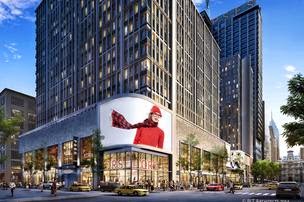
Despite new heights being reached north, south, east, and west, the most influential project under development right now is taking place on Market East. NREA's East Market is clearing and rehabbing the Girard Trust Block for a massive mixed use complex bound by 11th and 12th. The project includes shopping, entertainment, restaurants, and a mid rise apartment tower, perhaps two. In University City this might not seem so exciting. Hell, it wouldn't be unheard of in Conshohocken. But in Center City, developers tend to build up. East Market isn't necessarily tall, at least night in a city where we tend to look vertically. But Center City hasn't attempted a mixed use project on this scale since the Gallery at Market East. And unlike the Gallery, East Market isn't an attempt to offer urbanites suburban woes, it's offering city residents a slice of modern urbanism. Its storefronts face the sidewalks, and it sacrifices land for even more pedestrianization by slicing the block in half. It's ambitious, but not blindly. It's finally giving Philadelphians what they want on Market East, what they've wanted for fifty years, and what it was a century ago: a shopping hub. It's called "Market Street" for a reason. Sure, I may be gushingly deviating from truly Philadelphian pessimism, but it comes from a realistic place. East Market isn't another Gallery, it's the Gallery-done-right. The only reason it seems risky is because the Gallery is its only analogy. Architecturally, East Market is nothing special. Its modernity is carbon-copy, its tower looks like many built in the early 21st Century. The excitement of its renderings stems from plasma screens and flashy advertisements. But where East Market deviates from large projects past is its sustainability. It's engaging, it's smart, and it answers to what residents have been long asking for. It makes Market East feel less an island of poor urban planning and more like an integrated part of Philadelphia. Smart architecture doesn't just exist like Comcast Center or Centre Square, it engages the community and encourages future growth like Dilworth Park or the Piazza. It recognizes the fact that cities aren't just isolated buckets, but pieces of a larger whole. East Market isn't just good urbanism, it begs developers for more.