skip to main |
skip to sidebar
"A big idea and the intersection of great ideas," Market8 Casino has posted a, well, passionate video on their Facebook page.
I'm not sure I'd consider the Disney Hole and the Gallery the "intersection of great ideas," but I appreciate the effort.
Take a look.
Andrew Evans' Phantom Philadelphia shows composite images of Philadelphia's architectural loss.
Check out the very cool images here.
If you don't know who Fred Phelps is, I won't enlighten you. The dying minister behind the hate spewing Westboro Baptist Church doesn't deserve a biography. What is worth remembering is what this hate monger did to unite a nation against a common evil.
The enemy of my enemy is my friend, and Phelps proved that. However conservative or devout, no conscionable person could ever agree with the statements Phelps brought to funerals and memorial services.
He was a failure as a minister, never attracting a significant following. He was failure as a father, losing children and grandchildren, some who went on to fight for the causes he viscerally protested.
He held the same hostility towards AIDS victims and war heroes. His hatred didn't discriminate, he simply hated everyone. Because of Phelps, we looked beyond divisive politics and saw nothing but grieving families and struggling minorities being persecuted - as equals - by one truly evil man.
Whatever your faith Phelps showed us the devil. His hate proved that everyone else, regardless of our differences, could harness a modicum of compassion for those we dislike or don't understand.
Some have proposed protesting his funeral, but that would only solidify his legacy and historical relevance. He doesn't deserve the acknowledgement. He deserves a sparsely attended memorial service, the legacy of a hateful man despised by the world and loved by no one.
After a valiant effort on behalf of preservation activists, Live Nation didn't waste time beginning demolition at the historic Boyd Theater after last week's decision by the Historical Commission.
As often is with historically designated buildings in Philadelphia, there was a public misconception about what was designated historic. The most astounding aspect of the theater is its massive Art Deco auditorium, but the only piece protected by the Historical Commission was the façade which will be restored by iPic Theaters.
Philadelphia's independent blogosphere will likely follow the Boyd's demolition while the mainstream press will follow iPic's redevelopment. Meanwhile it's important to use the momentum generated by the Friends of the Boyd and the Preservation Alliance to move on to the next threatened historic site.
For the moment, I'm curious what will be salvaged from the Boyd's auditorium and where it will end up. A few months ago I was at Ted's Bulletin, a new restaurant on 14th Street in Washington, DC, and was surprised to see the entire interior adorned in the salvaged remnants of West Philadelphia's Convention Hall.
Convention Hall met a familiar fate, its demolition the result of University Hospital's ambitious development and last minute efforts on the part of preservationists. Before that happens again, let's get out in front of the next great loss. We need a Friends of Robinson's, Friends of the Roundhouse, and Friends of the Divine Lorraine to make sure we don't lose another architectural legacy.
Despite an anonymous offer to purchase the Boyd Theater from its current owners, the Historical Commission has agreed to let Live Nation demolish the historic theater. Why is entirely up for speculation. The purchase price of $4.5M didn't come with any guarantees. In fact, one very possible outcome from saving the Boyd's auditorium at the behest of advocates could have resulted in it sitting vacant for another decade, ultimately leading to the loss of the entire building. iPic Theaters has agree to restore the façade.
However given the Historical Commission's job performance, that doesn't mean the city had the theater's best interests in mind. The commission has allowed a number of properties that they deemed historic to crumble in the hands of slum lords and property hoarders, ultimately approving them for demolition.
The Historical Commission's namesake is a bit of a misnomer, and it's questionable whether anyone in the agency understands what constitutes history or why. It's a poorly funded city agency that reviews nominations for historic properties, then I assume they choose the prettiest and slap an arbitrary historic sticker on it. After that, private developers are saddled with the financial burden of restoring a crumbling relic. The commission does nothing to ensure the safety of its historic properties. Many, such as the Church of the Assumption, slowly become undesirable or even unusable pieces of property.
But the loss of the Boyd doesn't have to be a complete wash. This forgotten theater generated more awareness surrounding preservation in one of America's most historic cities than some of Philadelphia's most notable abandonment. There are lessons that have been learned and the commission's flaws exposed.
Sites like the Divine Lorraine and the SS United States are well known because their presence is so prominent. Their fate is unsure because they've sat vacant and stripped. But there are dozens of other sites in the city which, much like the Boyd, are completely usable yet unknown or unappreciated to those passing by.
Instead of dwelling over the demise of the Boyd, the momentum and public awareness it generated needs to be used to move on to the next threatened property: The Roundhouse, Robinson's Department Store, The Department of Public Health, The National Building. These are strange buildings, notable architectural examples that represent unique historic eras. They also sit on prime property ripe for redevelopment.
Maybe it's difficult for those vested in the past to look at the future. But all too often preservationists come to the aid of our historic properties the very moment it's too late. Let's not wait for the wrecking ball to come to The National Office of Big Brothers Big Sisters before we decide it's worth saving. And while we have the attention of the media and the public, let's take the Historical Commission to task for neglecting its sole responsibility: protecting our city's history.
 While religious nut jobs poke their nose into the politics of high profile cities like New York and DC, Philadelphia - perhaps thanks to the fact that many uneducated zealots think God was born somewhere in Missouri - has managed to fly under the radar.
We've elected Brian Sims, Councilman Kenney has proposed sweeping legislation at the behest of the LGBT community, and Mayor Michael Nutter stated he wants Philadelphia to become the "most LGBT friendly city" in the world.
Whether Nutter's lofty aspirations seem realistic or not, these are things that don't happen in other parts of the United States without resistance, even in cities as progressive as New York and San Francisco. Hate groups target high profile cities they deem influential, or sophomorically, "gay." Meanwhile cities like Philadelphia are free to charge ahead with an extreme lack of resistance, while the more prejudice aren't concerned enough with the lives of others to speak out.
Philadelphia is both the Wild West of gay rights and ahead of the curve. Basically, hate groups don't really know what to do with us. Which may be why Courage, a fringe Christian organization that claims to convert homosexuals to a heterosexual lifestyle decided to hold their local event at St. Charles Borromeo Seminary on City Line Avenue, far removed from citizens and politicos who would care.
Courage is in for a rude awakening when it comes to town on March 29th. Philadelphians have a unique outlook towards LGBT rights and, gay or not, are ruthlessly supportive of divergent lifestyles. Courage is versed in attacking the cliché protestors, but Philadelphians aren't cliché. Southerners are tight lipped when it comes to their convictions and what they choose to accept, New Yorkers and Washingtonians are divisively political, and the West Coast is chock full of vegan beet-burger fueled hippies, but Philadelphia is an anomaly of acceptance.
We may spew hate over bike lanes, parking, and dog poop, but when some evangelist swoops into town claiming he can "fix" our neighbor's kid, Philadelphians can throw back a kind of solidarity these hypocrites have never experienced.
These groups fixate on stereotypes because their understanding of our "condition" ends with stereotypes. That multi-ethnic mob of camouflage caps, baggy jeans, and South Philly moms descending upon St. Charles Borromeo in March won't be the support that Courage expects, it will be Southeastern Pennsylvania, South Jersey, and Delaware telling Courage to take its bigotry elsewhere.
While religious nut jobs poke their nose into the politics of high profile cities like New York and DC, Philadelphia - perhaps thanks to the fact that many uneducated zealots think God was born somewhere in Missouri - has managed to fly under the radar.
We've elected Brian Sims, Councilman Kenney has proposed sweeping legislation at the behest of the LGBT community, and Mayor Michael Nutter stated he wants Philadelphia to become the "most LGBT friendly city" in the world.
Whether Nutter's lofty aspirations seem realistic or not, these are things that don't happen in other parts of the United States without resistance, even in cities as progressive as New York and San Francisco. Hate groups target high profile cities they deem influential, or sophomorically, "gay." Meanwhile cities like Philadelphia are free to charge ahead with an extreme lack of resistance, while the more prejudice aren't concerned enough with the lives of others to speak out.
Philadelphia is both the Wild West of gay rights and ahead of the curve. Basically, hate groups don't really know what to do with us. Which may be why Courage, a fringe Christian organization that claims to convert homosexuals to a heterosexual lifestyle decided to hold their local event at St. Charles Borromeo Seminary on City Line Avenue, far removed from citizens and politicos who would care.
Courage is in for a rude awakening when it comes to town on March 29th. Philadelphians have a unique outlook towards LGBT rights and, gay or not, are ruthlessly supportive of divergent lifestyles. Courage is versed in attacking the cliché protestors, but Philadelphians aren't cliché. Southerners are tight lipped when it comes to their convictions and what they choose to accept, New Yorkers and Washingtonians are divisively political, and the West Coast is chock full of vegan beet-burger fueled hippies, but Philadelphia is an anomaly of acceptance.
We may spew hate over bike lanes, parking, and dog poop, but when some evangelist swoops into town claiming he can "fix" our neighbor's kid, Philadelphians can throw back a kind of solidarity these hypocrites have never experienced.
These groups fixate on stereotypes because their understanding of our "condition" ends with stereotypes. That multi-ethnic mob of camouflage caps, baggy jeans, and South Philly moms descending upon St. Charles Borromeo in March won't be the support that Courage expects, it will be Southeastern Pennsylvania, South Jersey, and Delaware telling Courage to take its bigotry elsewhere.
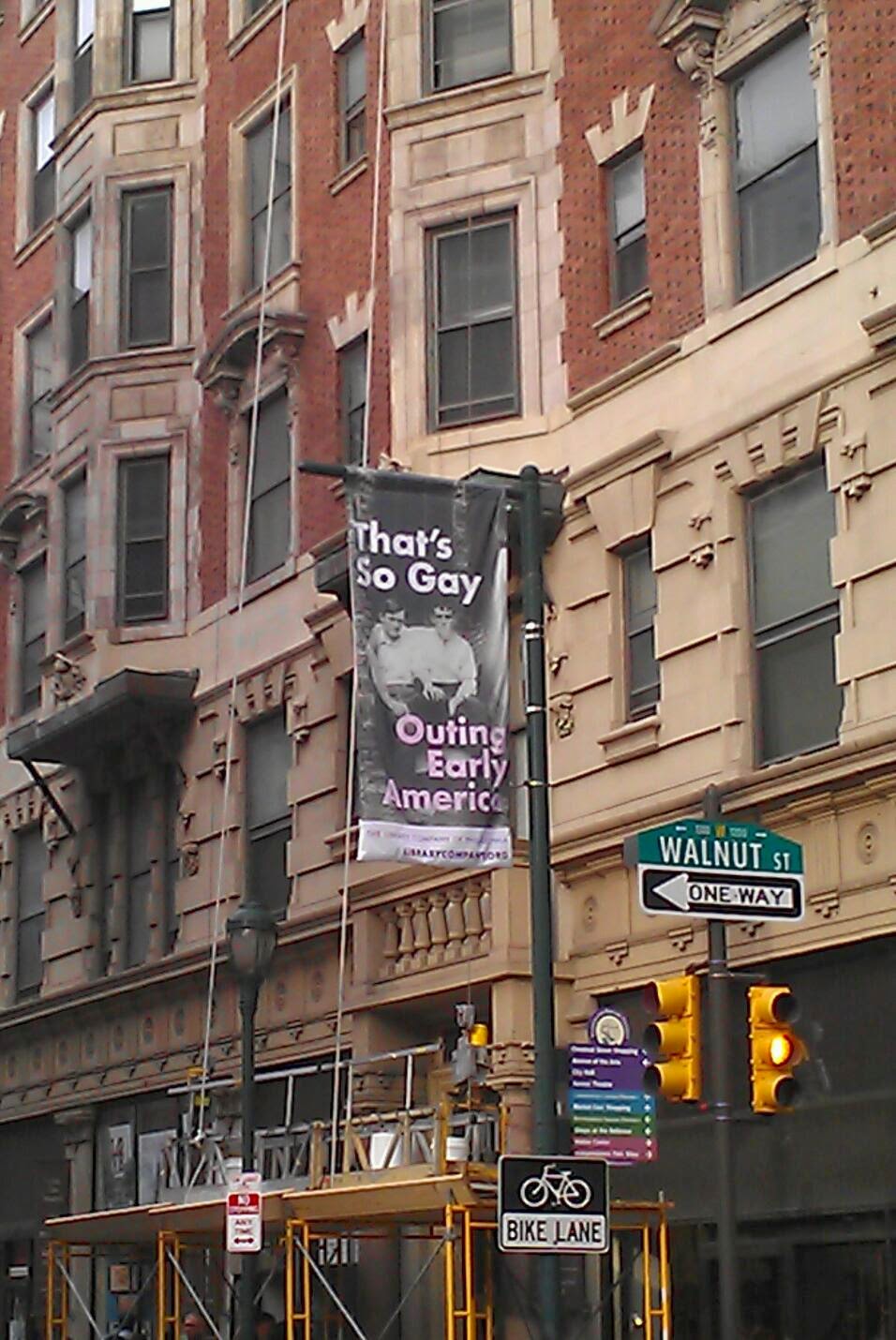 Through October 17th, the Library Company of Philadelphia will be exposing America's lavender history with That's So Gay: Outing Early America.
Of course the LCP admits the difficulty in pulling the "gay" out of a history that wouldn't recognize the word, but there's still an abundance of gender bending photography, poetry, and purported affairs of same sex couples that prove the past is not as rigid as our conventional history books lead us to believe.
Through October 17th, the Library Company of Philadelphia will be exposing America's lavender history with That's So Gay: Outing Early America.
Of course the LCP admits the difficulty in pulling the "gay" out of a history that wouldn't recognize the word, but there's still an abundance of gender bending photography, poetry, and purported affairs of same sex couples that prove the past is not as rigid as our conventional history books lead us to believe.


