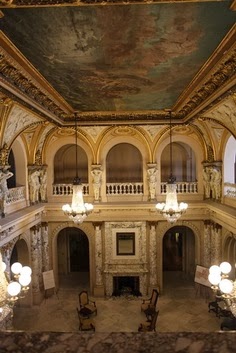
A friend recently turned me on to the work of Philadelphia artist Adam Wallacavage. With a BFA in Photography from the University of the Arts, Wallacavage ultimately branched out into plasterwork, becoming globally recognized for his ornamental octopus chandeliers.
Like a lot of artists, his work extends well beyond his most popular and public. Apartment Therapy toured his South Broad Street home and found a world as easily described as a waking dream. A work of art impossible to entirely absorb.
With its taxidermied fish heads, Victorian chachkies, and Key West colors, his living room might as well be a Steampunk Trapper Keeper painted by Lisa Frank.
"Now we know who's buying everything on eBay." -Will & Grace
Each room in Wallacavage's home is a display window for the best of Craigslist's Curb Alerts.
And I mean all of that as the utmost compliment.
It's not easy to bridge the gap between kitsch and art. Raised amongst the clutter of flea market shopping sprees, I have a soft spot for nostalgia and shelves of knick knacks that each hold a story, even the ones I make up. Online auctions have allowed me to amass my own collection of nonsense, or as much as a 19th Century Trinity can hold.
My friends say my house looks like that of a 23 year old hipster. A girl.
Mind you I'm a 37 year old man. I've mastered kitsch, but could only dream of turning my basement finds into the architectural Rabbit Hole that Wallacavage offers his guests.
He's given me the motivation to buy that jackalope I've always wanted, and his house has proven that there's nothing wrong with a seven foot tall hall tree in my very small bedroom.
Thank you, Adam.
Surprisingly Wallacavage is a self described minimalist. Well, he's genius enough to call himself whatever he wants, but I wouldn't consider a totem pole in the hallway...in Pennsylvania, Minimalism.
With its unorthodox color pallet juxtaposed against gaudy Victorian furniture his home looks like the site of a Katy Perry photo shoot. Would you be surprised to know that it is?
Like a Tim Burton dreamscape, although a little more alive, this unassuming Broad Street Brownstone could be the set of the forgotten Beetlejuice footage of Otho's own Manhattan penthouse.
"You're lucky the yuppies are still buying condos, Charles, so you can afford what I'm going to have to do to this place."
I might be one of the few people who actually liked the Deetz's house after Otho brought Delia's vision to life (or death).
Something tells me Wallacavage might have used the Maitland's Manchurian Tung Oil to finish an 18th Century curio in which to display some of Delia's "dangerous" sculptures, or his own.
Like this with an octopus chandelier and a red velvet chaise lounge from a Tenderloin burlesque house. Okay, so nothing like this.
Wallacavage hasn't gone the way of Isaiah Zagar and opened his workspace to the public, yet. His home remains a home, a place of inspiration for his own personal work. One can only imagine the unused corners of this house, the stacks of inspiration not yet incorporated into his living architecture.
Have you ever seen a Donald Roller Wilson painting up close? That might be what you'd find in his attic.
The Man Has Left the Moon Tonight - Donald Roller Wilson
Or maybe a miniature replica of Winter River, CT. Okay, no more Beetlejuice references, I promise!
While other Gilded Age mansions fight uphill battles towards preservation, two home owners plan to restore one many thought was lost.
Renovated by Horace Trumbauer with grounds designed by the Olmstead Brothers, Bloomfield in Villanova was destroyed by a fire in 2012.
After a year of Philadelphian litigiousness aimed at the property's residents, Julie Charbonneau and Dean Topolinski, finally ended, they have decided to restore Bloomfield.
With an $11M settlement, Charbonneau and Topolinski could have easily walked away from the tragedy, razed the ruins, and subdivided the desirable address.
However Charbonneau, native to Montreal, fell in love with Bloomfield the moment she saw it, never expecting to find a house this, well, French in America.
Her love for her Bloomfield has weathered the devastating fire, leading her to the Historical Society of Pennsylvania where she unearthed Trunbauer's orginal drawings of her house, allowing her to restore every detail of the original mansion using as much that remains as possible.
She's even employed D. Robert “Bob” Farrow, grandson on the man who built the house, as one of the carpenters working on the restoration. Farrow is even trying to locate the original plans for the house.
With carpenters enduring arduous tasks that haven't been employed since the 1920s, Charbonneau's ambition stands to challenge the region's notion of disrepair.
What's more, while the region's wealthy residents tear down perfectly livable landmarks like La Ronda to build their own Xanadu, Charbonneau's respect for the history challenges the American notion that land owners have the right to eradicate history just because they sit on a boat load of cash.
A little over a year ago, the recently opened Barnes Museum held a gala for the city's elite. For $1500, the city's wealthy art appreciators dined on lamb and drank champagne outside an institution that holds some of the world's most valuable artwork.
While attendees feasted and canoodled amid the landscaped Parkway in ball gowns and tuxedos, Occupy Philly staged a protest of sorts across the street, feeding the city's homeless in plain sight of the rich who were mixing and mingling.
Whatever you think of the Barnes Museum, their extravagant gala, or Occupy Philly, the one thing that all of those involved share was a message and a cause they believe in.
No one paid $1500 for a meal. Those privileged enough to attend the Barnes Gala did so out of a civic sense of pride, celebrating the end of a long fought battle to bring the museum to the city.
Likewise, Occupy Philly wasn't serving bologna sandwiches, but sending a message to those with means that a very real problem exists in the city beyond the hallowed halls adorning their artwork.
Both events took place side by side, as uneventfully as planned.
While the Barnes Museum made a handsome chunk of change to help maintain its priceless collection, wealthy philanthropists figuratively shook hands with the city's less fortunate.
Both had a cause, and in that, both succeeded.
Often these events are mundane on the surface, but the fulfillment comes from knowing that you participated in a cause you strongly believe in. Anyone on 20th Street that night walked away knowing they did something good.
I'm certainly not suggesting that everyone, rich or poor, spend all of their time advocating for a better world. It's exhausting, and too much can even contribute to a sense of self righteousness.
Treat yourself.
The city hosts plenty of public events like Welcome America! and our annual New Years Parade. They cost the city money, profit their sponsors, and they make the city an exciting place to live.
Whether you're at the Barnes Gala, an Occupy protest, or Welcome America!, no one can really ask, "why?" Charitable events fund organizations that need it, or at the very least support a cause that attendees believe in, and public celebrations drive tourism and are a good time for everyone.
But occasionally an event comes along that culminates in nothing more than the indignant end result of too much charity, without actually providing any.
I'm talking of course, about the BYO everything Diner en Blanc.
Why?
Well, you can ask that simple word until the end of time and no one will give you an answer.
With an inside invite, you too can pretend like you're one of those philanthropists outside the Barnes Museum without actually doing anything...except for bringing your own dinner, wine, and adhering to the most tedious dress code this side of a fetish party.
Remember when Barbara Streisand brought her own white microphone to the Opera show? Imagine that microphone personified as 2500 Philadelphians who desperately want to feel special.
What is Diner En Blanc? Well it's a flash mob with a cover charge. Invitees show up in white with picnic baskets and chairs and dine amid our city's historic landmarks. Organized by Diner En Blanc International, it's an event that takes place yearly in many cities around the world.
But it doesn't exist for any reason other than that it exists.
What's most deplorable about Diner en Blanc is that it specifically excuses its complete lack of philanthropy as part of its tradition. It clearly states, "There are no sponsors, no political or ideological agendas."
Of course that statement is immediately false in that Diner en Blanc International is a profitable organization that is itself, the sponsor. For the privilege of shelling out roughly $30 a head (or $60 for two, since couples are required), you too can throw money at an organization that straps the resources of your local municipality to profit a collection of event planners.
When a city as broke as Philadelphia is asked to close Logan Square for a bunch of invite-only d-bags and their sense of self righteousness, it's kind of a slap in the face.
Ironically Diner en Blanc touts itself as a collection of "friends" who enjoy good food without actually providing any. Yep, Diner En Blanc is entirely BYO. The whole premise is to feel exclusive. Of course exclusivity for its own sake means nothing, something the attendees don't seem to get. Or maybe they do. Maybe they're just bad people. Maybe they're the kind of people who walked away from the The Great Gatsby thinking, "wow, what an awesome party." While those charitably connected routinely attend events knowing exactly what attire is appropriate, Diner en Blanc specifies a laundry list of adjectives and seems predominantly focused on the phrase, "astonished looks from passersby."
In that regard it is a flash mob, but stripped of its fun and spontaneity...and freeness. The tediously laughable dress code only proves that people who use the words "classy" and "elegant" aren't.
"...the greatest decorum, elegance, and etiquette...a mass 'chic picnic'..."
"...a love of beauty and good taste."
"...the elegance and glamour of court society..."
"...a picnic basket comprised of quality menu items and china dinner service...be dressed elegantly....stylish and denotes taste."
"...no disruptions...except for the
occasional amazed and astonished looks from passersby at the scene
unfolding before them. And we, as they, wonder whether it's all not a
dream..."
In other words:
"Do you like steak? Try eating it, under a chandelier."
Attending galas can be a good time, and sure a part of that is self satisfying. When someone walks up to an event and asks, "What is this for?" you can plead your cause or ask them to join you.
What do these people say? Well, most will tell you its a standing tradition dating from France that has spread around the globe. While that's true, what most likely don't know is that it's a tradition dating from 1988. Sometime between gym class, blasting Depeche Mode from my '82 Volvo, and bagging groceries at Food Lion, François Pasquierwas looking for his friends in Bois de Boulogne.
How he found them? He told them to wear white. Sure, that's cute. But it's not quite as romantic knowing that the tradition dates no earlier than the year Critters 2 came out.
Chelnetham Township's commissioner, Harvey Portner has said little about the forlorn Lynnewood Hall, at least nothing more than "it can be and should be developed into something magnificent." It's hard to know exactly what he means, and speculating isn't fun.
The township has been firm. Unless Richard Yoon's petition to the Supreme Court makes waves in Cheltenham, the owner of The First Korean Church will not be able to operate the property as a tax exempt church or school.
Currently Yoon pays over $130,000 in taxes yearly, and he'll likely unload the property if its tax status doesn't change.
Cheltenham is a nice enough suburb, but it isn't as renowned and cash flushed as other areas. Portner has a job to do, and losing $130,000 every year isn't part of it. In that regard, Portner's stance may seem reasonable.
It's a shame, because Lynnewood Hall is one of the regions most spectacular examples of Gilded Age architecture. Designed by Philadelphia's own architect to the stars, Horace Trumbauer, Lynnewood is the ninth largest historic home in the United States, 5000 square feet larger than Newport, RI's Breakers.
We learned our lesson when Whitemarsh Hall was demolished in the 1980s, the third largest historic house in the United States. When La Ronda was demolished a few years ago, preservationists and historians across the country were devastated, yet Addison Mizner's Spanish style masterpiece pales in comparison to Lynnewood Hall.
Enough locals don't realize what's at stake here. Landmarks like Biltmore Estate are household names, even for those with no interest in architecture or history. I know I don't need to say this to anyone reading an architecture blog, but that's what Lynnewood is.
It's City Hall. It's the Philadelphia Museum of Art. It's Philadelphia's foremost example of Gilded Age architecture, perhaps even the Northeast's.
If Portner wants something "magnificent," he already has it.
Beyond the rusted gates of Lynnewood Hall, Cheltenham has something even more magnificent, something no other region in the country can claim.
Lynnewood Hall is not alone. As stately as the manor is in itself and its grounds, it's simply one part of a complex of architecture history unrivaled in the United States, all of which lie dormant.
Across the street from Lynnewood Hall is not one Gilded Age mansion, but three.
Elstowe Manor, the seventeenth largest historic house in the United States was abandoned in June of this year. Known as the Elkins Estate, the grounds are comprised of Elstowe Manor and Chelten House. Additionally, Georgian Terrace was abandoned by Temple's Stella Elkins Tyler School of Art a few years ago, also empty.
Fortunately none of these properties have succumbed to the death of architectural hope otherwise known as tax delinquency, but with the Elkins Estate taxed at more than $300,000 a year, it's even less likely that the township will grant any of these properties the exemption they need to survive much longer.
As if the architectural significance of these properties isn't enough, their history is unparalleled. All built for the Widener and Elkins families, these estates once carved out a private enclave for the tycoons that built the Philadelphia we know today. It's inarguable that their contribution to the region, even the nation, deserves the dignity of salvation.
When you consider this site's significance and the unique fact that this compound remains intact, Portner's position goes beyond the scope of his local responsibility, but also taps an obligation to the nation. While this land could stand to profit from townhomes and condos, this is one of those rare occasions when money doesn't matter.
What's most disconcerting is Portner's absent resolve for a specific outcome. This leaves the preservation community and the region in the dark. These properties are more than simple homes and the township has an obligation to responsibly address these assets as the benefits to the community that they are.
Without the township fielding investors, it leaves the job up to preservationists and realtors. But without a statement from the commissioner other than it should be "something magnificent," those concerned about the fate of these mansions can do little.
Can it be a school? Can it be converted into condos? Can it be a museum?
No one knows.
Without an interest from those in charge, realtors and property owners are saddled with finding buyers willing to use the properties as they were zoned. In the case of Lynnewood Hall, that's as a private home, which at 70,000 square feet, is a tough sell in Cheltenham Township.
Cryptic comments from those presiding over the nation's most significant chunk of unused real estate call their motives into question. Sadly, the most realistic possibility is one that happens all too often.
Could Harvey Portner simply be awaiting the inevitable, wherein property owners unable to sell simply abandon their tax obligations, allowing the mansions to be seized by the township and sold for scrap?
When I first saw the new rendering for the Market8 Casino, I have to admit, I was a little excited. Giddy, even. We don't see a lot of proposals for new high rises in the city, particularly ones that deviate from a simple glass cube. Market8 certainly does that. Still, as Philebrity rightly pointed out, this casino won't happen. If we get another casino, we'll likely wind up with The Provenance or Wynn, the former being more exciting and, at the Inquirer Building, most central. Market8 spokeswoman Maureen Garrity and lead developer Ken Goldenberg excitedly talk about engaging the site with the sidewalks, providing restaurants and retail space at street level with the casino upstairs. That's a noble gesture and one that respects its location. In fact, in that regard, were we to actually see Market8 on Market East, it might just be the most respectful casino in any major city that doesn't exclusively cater to gambling. Of course some of the more dangerous threats from Center City casinos come with their routinely phased development. Market8 might be pitching its casino with a high rise, but if this were to play out like SugarHouse we'd be left with a lackluster stump that looks a lot like a suburban movie theater. Then there's parking. Market8 has clearly provided a parking garage in its design, and it appears that the surface lot on 8th and Chestnut is still available in the rendering. But SugarHouse provides a similar configuration, plus acres of surface parking lots sometimes full. It won't take long for predatory land hoarders to recognize a demand for supplemental parking and begin buying up and demolishing adjacent buildings. Keep in mind, historic Jewelers Row is a block away. Market8 can't be blamed for this, particularly when the Pennsylvania Convention Center was allowed to move forward with no designated parking. But until the city sets a moratorium on private parking or raises the taxes on these lots, any casino in a depressed zone like Market East or North Broad unintentionally threatens the surrounding architecture. Beyond the possibility that Market8 could replace the Disney Hole for an even larger Casino Hole, there's the redesign itself. Market8's previous rendering called for a low profile building running horizontally between 8th and 9th. It was sleek and modern, but also subtle and sophisticated. Of all the proposed casino designs in Philadelphia, it was the most applauded, even by some in the casino opposition camp. But for some reason, Market8's design team decided to throw out their webbed facade for something entirely different. Maureen Garrity and Ken Goldenberg pitched the latest incarnation as a nod to the corridor's historic infrastructure, siting it a modernist interpretation of Wanamaker's or Gimbel's, essentially suggesting the more traditional approach is what we'd expect to see if Market East were the thriving commercial it should be. I see what they're getting at. Market8's geometric shapes and ABC color palette reference recent proposals for a revived Girard Trust Block and renovations for The Galley at Market East.
Previous Proposal for Market8
It's unfortunate because the previous design was a nice start. Even if Market8 faces an uphill battle, one it will likely lose, exciting proposals are exciting nevertheless. Instead of building on the prior concept, Market8 decided to play with a tub of Lego Blocks and gave us a collage of recycled postmodernism.
Inquirer writer Thomas Fitzgerald made a nostalgic pitch for Ed Rendell's return to City Hall. Of all the word's in Fitzgerald's article, one that wasn't mentioned was "frustration," the one word that encompasses why anyone would seriously entertain the notion.
In all fairness, Fitzgerald does refer to the political nostalgia surrounding familiar candidates, or even names. But he doesn't explore why it's happening.
Philadelphians are frustrated. Pennsylvanians are frustrated. Americans are frustrated. Yes, even Earthlings are frustrated.
These are frustrating times. But they're also new times.
Whether or not you think Rendell was a great mayor, corrupt, or just plain bad, write a book about him. What our mayor did from 1992 to 2000 isn't relevant in the scope of today's Philadelphia. It's a different city.
Voters have become so jaded that many can't even consider a candidate they've never heard of. Democrats who don't like Rendell would likely vote for him, even in a primary election, simply because a familiar mayor - good or bad - is better than the fear of the unknown. How frustrated do we need to get before that changes?
When writers like Fitzgerald aren't looking for candidates through their rose colored glasses, they're looking at our corrupt City Council for the least corrupt to put up against a Republican sent to the podium to lose.
This political agoraphobia is echoed at all levels of Democracy, in every country plagued with the demons of political bitterness. How many times will Russian voters allow Vladimir Putin and Dmitry Medvedev to swap places? As soon as Hillary's too old to run, will we be pitting Chelsea against one of the Bush twins?
What are we afraid of?
Will Philadelphia collapse upon itself if we elect someone who isn't familiar enough with our institutional corruption to be a part of it? It's sad that Philly.com keeps running articles about Philadelphia's doomed future as the next Detroit, yet can't hold a political discussion about a candidate who isn't recycled. Detroit's last mayor had a familiar name and look how that worked out.
Our mainstream news outlets can't talk about viable politicians like Tom Knox and Sam Katz without giving a nod to the frustrated Philadelphian, assuring us that these outsiders don't stand a chance.
Instead of exploring candidates who bring a new voice to the city, the media focuses on rogue candidates like Pia Varma or Larry West who entered their races to make statements about the internal corruption of our political machine, not to win. Instead of focusing on their messages, the media told fear ridden voters, "if you vote outside the box, this is what you'll get."
The media and the local political structure have taken that message and expanded it to anyone unfamiliar, no matter how boringly reasonable the candidate is. Philly.com wants you to think that Sam Katz is synonymous with Pia Varma. City Hall thanks them, and picks out the next mayor like they're deciding what suit to wear on an idle Tuesday.
Rendell fans might think they loved him thirteen years ago, but everyone's fooling themselves if they think they didn't hate him as much as they hated any mayor in charge. The same goes for Clinton, Reagan, Rizzo, and someday, Obama. The only thing anyone loves about a politician is their election campaign and history.
The one reason anyone wants Rendell to be mayor is because he's not Nutter, or simply not now. Rendell may be a better mayor than one of the cronies in City Hall, but what does it say about voters when our only expectation is that a candidate be "better than" a potential disaster?
Rendell is better than a lot of people, but a lot of people are better than Rendell. We know that the next mayor will likely be appointed from City Council, so in that context, Rendell is inspiring. But the only reason he's a beacon of hope is because the Democratic party looks at Philadelphia as a city it already owns.
Why would the party waste quality stock on a city that continues to elect itself? The party has become the city's slumlord. The bigger question might be, why do local Democrats continue to apathetically respect that?
On a more transparent level, the problem with looking at retired politicians for anything more than a biography is that we attribute everything from that era to them. Philadelphia got a lot better during Rendell's time for a lot of reasons. The national economy was on the upswing, Communism fell, there was no such thing as a War on Terror, little of which had anything to do with Rendell.
It was a more optimistic time. He can't bring that back.
Since 2001, Americans have been convinced that the world is a scary, scary place. In the late 20th Century, change was exciting. We looked forward to new technology, expanded wealth, and unfamiliar politicians.
When we got a world of change we didn't ask for, politicians took note and elections became scary.
Fans of Rendell can site all the statistics they want, and the foes can follow up with their own. The truth is voters tend to look at pockets of history and embrace the "those were the days" ideal.
When an irresponsible tabloid paints us a glossy picture of what the city could look like if their hero returns, his fans embrace the fallacy that they won't start hating him the day after he's elected.
3601 Market, part of the University Center Science Center and a mixed use apartment and commercial tower, will now be a little taller and a little bit more interesting.
Perhaps riding Drexel's new style guide, BLT Architects will be staggering many of the windows and some of the balconies on the 300 foot high rise. While it's not quite as exciting as Campus Crest's Grove or Drexel's most recent additions, BLT has angled the 28 story tower towards Center City to offer residents a view of the skyline.
Of course with seemingly no cap on University City's rising skyline, Center City developers might soon be offering their potential tenants a view of a new Philadelphia, one west of the Schuylkill River.